Showing posts with label Condemnation. Show all posts

Friday, March 20, 2026

Mark 16:15-20 - An Unusual Text

Mark 16:15-20
And He said to them, "Go into all the world and preach the gospel to all creation. He who has believed and has been baptized shall be saved, but he who has disbelieved shall be condemned. And these signs will accompany those who have believed: in My name they will cast out demons, they will speak with new tongues, they will pick up serpents and if they drink any deadly poison, it shall not hurt them, they will land hands on the sick, and they will recover." So then, when the Lord Jesus had spoken to them, He was received up into heaven, and sat down at the right hand of God. And they went out and preached everywhere, while the Lord worked with them, and confirmed the word by the signs that followed.


Time: Mark's personal connection with Peter gave him the source material for this book. This book was composed probably between AD 57 and AD 59. It's a book that is on the move, leading to the cross. 39 times is the word 'immediately' used. Mark reveals Jesus as God's servant, reaching into the lives of people and effecting physical and circumstantial change.

What the Lord is Saying: The end of Mark is disputed as to whether verses 9-20 were part of the gospel or were added on later. In verse 15, the words are recorded that Jesus is sending His disciples into the world to preach the world. The idea is very similar to Matthew 28:19-20 in which are relayed Jesus' final instructions to his people to do the same, "Go and make disciples."  

So what is this text saying? 

For one, something will have to the person that doesn't believe, "he who has disbelieved shall be condemned." This is a clear statement, but whether in the New Testament or Old Testament there has always been the message of those that are chosen and those that are not. The difference here in these verses is the idea that the chosen one's are not as much ordained by God but have a choice - they can believe or not believe. And yet throughout our Old Testament, even the words or actions of others is part of the plan of God. In our free will choices, God's sovereignty holds true. I still to this day wrestle with idea of free will as I don't understand if we really have it, if God works out our free will choices for His purposes. But I suppose that is another matter to ponder in another lesson. The point here is simply there are the "have's" and the "have not's." There are the saved and there are the condemned. To believe is to believe in the gospel or the good news. 

This gospel I think is more broad than it is narrow. It is the kingdom of God on earth and the kingdom of God one day in heaven. The bottom line is we preach these words of this text and try to hold true to those words and its meaning. Mark started his book by starting with "the beginning of the gospel" by announcing it's coming and in verse 14 Jesus preached the gospel saying, "The time is fulfilled, and the kingdom of God is at hand, repent and believe in the gospel." Jesus gives actions - repent and believe. But once again the gospel is not clearly described. There is instead some idea that everything that Jesus says is the gospel. He will give us actions that we will need to do. 

Going back to this text here in March 16 at the end. After Jesus in these words differentiates people into those who believe and those who do not, he now speaks more directly about the fruit of those who believe - basically those that believe will carry out some actions that, in this day and age, are rather supernaturally: 
  • in My name they will cast out demons
  • they will speak with new tongues
  • they will pick up serpents and if they drink any deadly poison, it shall not hurt them, 
  • they will land hands on the sick, and they will recover
In other words, these believers will carry out some things that will clearly set them aside as believers. 

Thus, there are some supernatural events that will occur. God works and God will work through His people, for His glory. He will do supernatural things and His people will do them. 

We are followers. Yes. We make responses. Yes. But we also are commissioned to do great things in people's lives. As believers, we will do things that will catch people off guard. We will do things that for some will be great things people see and point people back to God and for others it will only give them reasons to disbelieve more. 

And this passage concludes with a more radical statement, "they went out and preached everywhere, while the Lord worked with them, and confirmed the word by the signs that followed." We are to go out and preach - everywhere. And as we do this, the Lord is with us and working with us in this preaching and supporting. Yes, he is in heaven, but he is still working. He is with us which means a part of Him must be present with us and to this we will say it is His spirit. And through this working, the words of the Gospel will be confirmed by the signs or the supernatural things we do. 

Look out for the supernatural. It will be in the believer's life. 

Prayer: O God, you are rich in mercy and love. And you want me to be your messenger. I believe and You work. You give me belief in You that is supernatural and in response you will do supernatural things through me. Forgive me God for wanting to only focus on the supernatural and give myself praise for when those events happen. Help me to see that they will happen as we have faith and trust in You. But no matter what keep me focused on preaching the gospel. Keep me focused and thanks for working for me and through me and helping me carry out these truths in our world. 


Note: If you are interested in other studies/devotions, check out my index of Bible Study's.

Monday, March 11, 2024

John 13:12-17 - The Example of Jesus

John 13:12-17
12 And so when He had washed their feet, and taken His garments, and reclined at the table again, He said to them, "Do you know what I have done to you? 13 You call Me Teacher and Lord; and you are right, for so I am. 14 If I then, the Lord and Teacher, washed your feet, you also ought to wash one another's feet. 15 For I gave you an example that you also should do as I did to you. 16 Truly, truly, I say to you, a slave is not greater than his master; neither is one who is sent greater than the one who sent him. 17 If you know these things, you are blessed if you do them. 


Time: John most likely wrote between A.D. 85 and 90. John's purpose in writing was, "that you may believe that Jesus is the Christ, the Son of God; and that believing you may have life in His name (John 20:31)."  

What the Lord is Saying: One of the first things I notice here in this passage is the dual application Jesus gives here of washing feet. In verse 11, He mentions being made clean. And now He also points to the idea that we are to follow or practice the acts that Jesus has done. 

    Luke 6:31 - Treat others the same way you want them to treat you.
    John 13:34 - A new commandment I give to you, that you love one another, even as I have loved you,     that you also love one another. 
    Matthew 6:12 - And forgive us our debts, as we also have forgiven our debtors.

In the previous passage, Jesus made it clear to me that being His disciple, being in the Kingdom of God is first found through trusting and accepting Jesus and then we follow through by keeping the commandments of God. Seek Him First though. And then these other things follow. And yet, I do understand that by themselves, these are principals that we want to have in our lives. These are ideas that should be in the hearts and minds of people always - to not simply be served. 

Matthew 10:24-25 - A disciple is not above his teacher, nor a slave above his master. It is enough for the disciple that he become like his teacher, and the slave like his master.

Again, people have roles and duties, but that does not make anyone better than another person. And yet the reality is religion has at many times painted a different picture, a picture that makes it seem like religion is controlling people and how they think. But at the heart of the matter here is that we are to be servants and treat others the way you want to be treated. 

This is a tough principal I think sometimes in our lives now to apply - as our world continues down a course of not coming from its foundation of Christian living or defined by biblical ideals, but is shifting what is deemed right and wrong, it challenges the Christian on how they are to live and respond in these situations. I remember my good friend Bobby and I walking together in the mall many years ago and he wondered about a friend that is practicing homosexuality and wondered if he would be invited to their same sex wedding if he would attend. It was a challenging question and one I don't think we were able to resolve with an answer at the time. And yet many would not see any issue with a response either in an affirmative or not. I think these are hard situations in our lives and so I think we need to extend perhaps a little grace to one another even as we have different opinions. 

A prominent pastor and Bible teacher recently gave a response on his national call-in show of him counseling a grandmother's question of whether to attend one of these same-sex or transgender marriages and stating she could go (starting at 16:09) to maybe surprise her with a response that perhaps she wasn't expecting. And yet this response was immediately rejected by a prominent Christian pastor. 

Now I am not saying here there is a link with foot-washing and celebrating sin, but there does seem to be a principal here of the way we treat one another, even the way we treat one another when we disagree. Do we continue to live alongside these people and show them respect or is our response only to address their sin and show that their response to sin will keep them from the kingdom of God, if that is what we believe. I think it is a hard situation and response and so I think it needs grace. 

But this passage is more specifically giving the teaching that as we receive service towards us, we are to return that service to others. We are not to take a position that we are higher or mightier or on a different level from others. We are to remain servants. And yet from that I went off on treating others the same and then wondered if that treatment affects how sinners might trust in Jesus. And so maybe I am just concluding these are hard situations for me to apply. 

Summary: Disciples of Christ must be willing to do what Jesus was willing to do, including acts of service. 

Promise: From Tabletalk -- we can imitate Jesus in being willing to go to great lengths to meet the needs of others. We should begin our service at home, putting the needs of our spouses and children ahead of our own. But we should also put others ahead of us wherever else we may go.

Prayer: Lord, your principals that you give us move me to compassion and serving others. I want to be a person that is about love and yet stand firm on the fact that we are each sinners in need of being restored to You for salvation. Help me to understand these texts and perhaps not get too sidetracked by their meaning as even I have probably done in this lesson. Thank you Jesus for washing the disciples feet and being a servant and being different and showing all mankind that You are different. Give me guidance and forgiveness of others as well, even those I disagree with. 


Note: If you are interested in other studies/devotions, check out my index of Bible Study's. 

Thursday, March 7, 2024

John 12:47-50 - Christ the Judge

John 12:47-50 

47 If anyone hears My sayings and does not keep them, I do not judge him; for I did not come to judge the world, but to save the world. 48 He who rejects Me and does not receive My sayings, has one who judges him; the word I spoke is what will judge him at the last day. 49 For I did not speak on My own initiative, but the Father Himself who sent Me has given Me a commandment as to what to say and what to speak. 50 I know that His commandment is eternal life; therefore the things I speak, I speak just as the Father has told Me.

Message: Christ the Judge

Time: John most likely wrote between A.D. 85 and 90. John's purpose in writing was, "that you may believe that Jesus is the Christ, the Son of God; and that believing you may have life in His name (John 20:31)."  

What the Lord is Saying: Tabletalk mentions today in this devotional. a consistent theme in the Bible, a contrasting outcome of all people: 

Daniel 12:1-2 - "Now at that time [the time in which troubles are the greatest; typically, towards the close of Antiochus' reign; antitypically (foreshadowing), the time when Antichrist is to be destroyed at Christ's coming] Michael, the great prince who stands over the sons of your people, will arise. And there will be a time of distress* such as never occurred since there was a nation [that is, ever since the world was, from the beginning of it, from the creation of the world] until that time; and at that time your people^ everyone who is found written in the book# [the first contrasting outcome - those written in the book], will be rescued. And many [more likely 'all'; but still may be specific still to Israel prominent during the reign of Antiochus] of those who sleep in the dust [grave] of the ground will awake, these to everlasting life, but the others to disgrace and everlasting contempt [the second contrast - those resurrected to eternal contempt]."

* - Matthew 24:21 - for then there will be a great tribulation, such as has not occurred since the beginning of world until now, nor ever shall

^ - "the Jews, the people of Daniel; these shall be delivered not only from the then present outward troubles, not only from their present captivity and afflictions, but from their spiritual evils; from the bondage of sin, and the captivity of Satan; their disbelief of the Messiah; their confidence in their own righteousness, and attachment to the traditions of their fathers; they shall be turned from their transgressions, and return to the Lord their God, and David their King, and shall be truly converted, and spiritually and eternally saved..." - John Gill (1697-1771); Romans 11:25 - "For I do not want you, brethren, to be uninformed of this mystery— so that you will not be wise in your own estimation— that a partial hardening has happened to Israel until the fullness of the Gentiles has come in."

# - "By those found written in the book, or, as it is expressed, Isaiah 4:3, 'written among the living in Jerusalem,' may be understood, 1st, The pious Jews who should be preserved from the mischief and ruin designed them by Antiochus; but more especially, 2d, Such as should believe in Christ when he appeared, embrace his gospel, and become his true disciples, who should escape both the temporal calamities coming on their countrymen, and obtain spiritual and eternal salvation through him. It includes, 3d, Those who should be converted in the latter days, and restored to their own land; and lastly, All that should be found written in the book of life at the day of final judgment, that is, all truly justified, regenerated, and pious persons." - Joseph Benson (1749-1821).

This is one of my first times to take a moment in studying Daniel 12:1-2. It is interesting to me that the contrast of death and life is not always only spoken of in the Bible as occurring upon physical death but that which occurs also from spiritual death to spiritual life. Our death being in our sins and then the turning point of life which occurs by God (Glory Be!) like is mentioned in Ephesians 2:4-6, "But God, being rich in mercy, because of His great love with which He loves us, even when we were dead in our transgressions, made us alive together with Christ and raised us up with Him, and seated us with Him in the heavenly places in Christ Jesus." As Daniel 12:1 ends, "will be rescued." That idea of being made alive and being rescued places the glory completely on God and just continues to mesmerize me and challenge my thinking. 

This leads us to this text and the dividing line between life and contempt, salvation and condemnation. Verse 47 is an interesting verse as it specifies that hearing and not doing does not merit judgment. In other words, it seems the key here is verse 48 and rejecting Jesus. Following Jesus' teachings is not salvation. Following Jesus is the key. It is accepting Him. It is a combo of rejecting Him AND not receiving His sayings. The focus is not works. I'm immediately reminded of those that only speak of Jesus as a good teacher. Their focus is simply on what He has said and doing what He has said. But they are not acknowledging Jesus as the one who saves. They are rejecting His allegiance with God and having been sent by God. 

The words of John of Jesus are so clear. He speaks, but He speaks from the Father - "just as the Father has told Me."

Summary: The consistent them of the Bible is people go to everlasting life or everlasting contempt and believing in God, believing in Jesus, sent by God is the dividing line. 

Promise: It is urgent to believe in Jesus now.

Prayer: God, it is good to get into your Word and read it. I thank you for the encouragement of my friend Scott and his simple words yesterday of diving in Your words and studying them and that reminder that I have been living without this the last 2 weeks and realizing my time today with You needed to be important and a priority. So thank you for the richness of Your words today and the greatness of the salvation You have given me. You have rescued me. You have made me alive in Christ. I am forever in Your care, forever with You, starting now. All glory goes to You. 


Note: If you are interested in other studies/devotions, check out my index of Bible Study's. 

Tuesday, August 1, 2023

John 3:17-18 - Why God Sent His Son

John 3:17-18
17 For God did not send the Son into the world to judge the world, but that the world might be saved through Him. 18 He who believes in Him is not judged; he who does not believe has been judged already, because he has not believed in the name of the only begotten Son of God.


Time: John most likely wrote between A.D. 85 and 90. John's purpose in writing was, "that you may believe that Jesus is the Christ, the Son of God; and that believing you may have life in His name (John 20:31)."

What the Lord is Saying: As mentioned today in my Tabletalk reading, "we should note that most commentators believe that verses 16–21 were not spoken by Jesus but are rather John’s expanded commentary on Jesus’ meeting with Nicodemus." It somewhat makes sense because it seems odd in a way for Jesus to say these words about Himself and God. Jesus always spoke of himself as the Son of Man and yet here the reference is to Son of God. And yet because they come from John does not make them any less significant. Verse 15 and 16 is a culmination of the words spoken by Jesus to Nicodemus on needing to be born again. 

Verse 17 is further clarification and the reason God sent Jesus to the world, for salvation to all people. God's desire is to save people. And the way we are saved is through Jesus. Jesus provides a way for sinners to escape condemnation. He is the way and I still can't see how this can be a partnership. To me, it is either Jesus does it all or man does it, but I do not see how it can be shared. 

But condemnation or judgment is the result of not believing. 

I think many thought of the day that the Messiah would come to condemn. Man deserved this. But in these words we see pardon instead. He will at some point judge the living and the dead but his first mission is to save. I see this often in the Old Testament, God's love for His people, their disobedience, His punishment but then also His pardoning of their sin, in order to restore and keep them as His people. God wants to be praised, I believe. 

Summary: Those who look to Christ escape condemnation, but those who refuse to trust Him are as good as condemned already.

Promise: As we share the gospel with others, we need to take care to warn them that rejecting Christ as Savior will mean their eternal condemnation.

Prayer: You are Savior and You are Lord. Thank you for saving my soul. Thank you for making me whole. Continue to draw people closer to You in every way and bring grace and mercy to the world. Help me direct people to the truth of being born again. 

Thursday, June 17, 2021

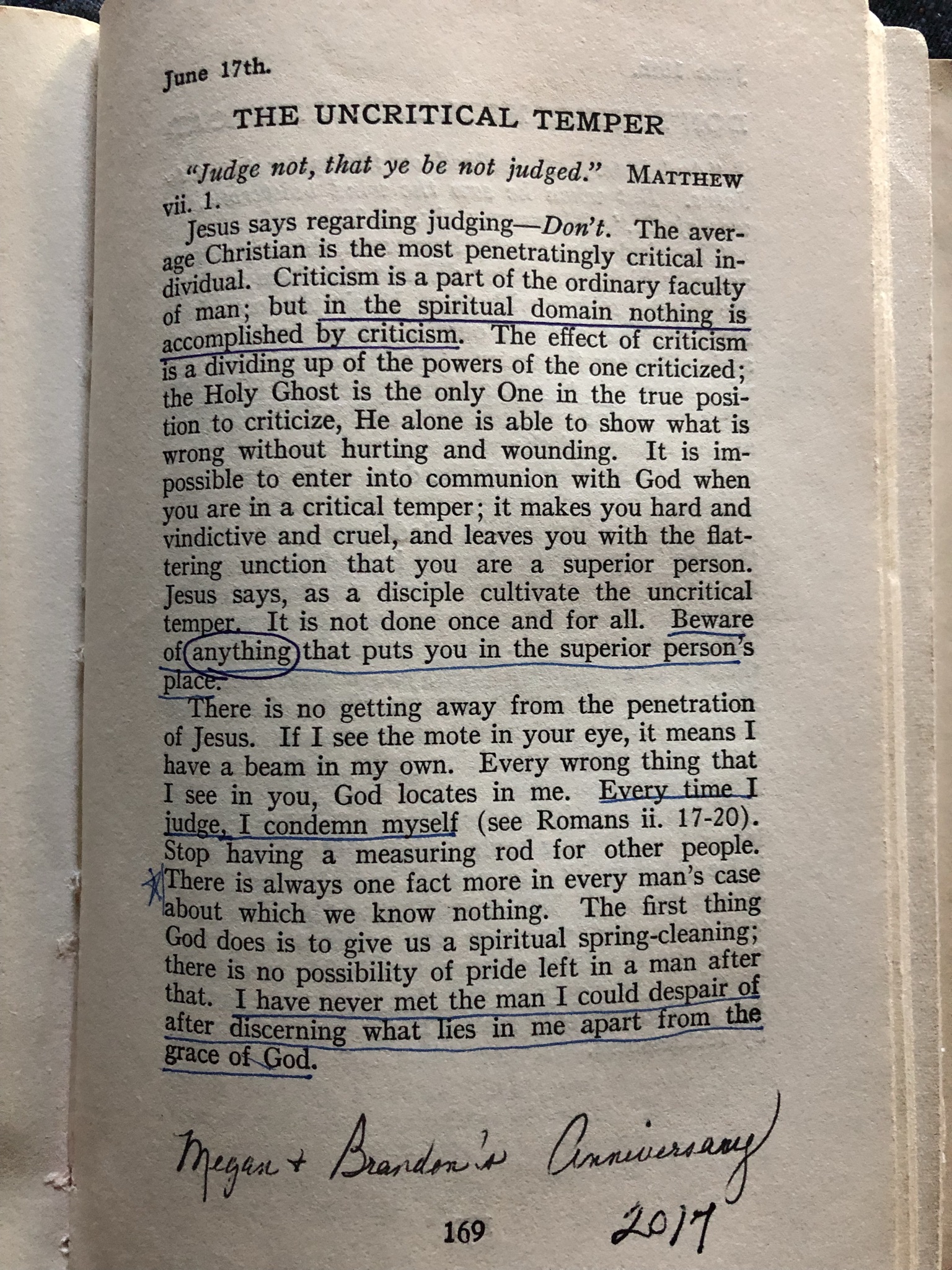
My Utmost for His Highest - June 17th - The Uncritical Temper

Judge not, that ye be not judged. - Matthew 7:1

    Jesus says regarding judging — Don’t. The average Christian is the most penetratingly critical individual. Criticism is a part of the ordinary faculty of man; but in the spiritual domain nothing is accomplished by criticism. The effect of criticism is a dividing up of the powers of the one criticized; the Holy Ghost is the only One in the true position to criticize, He alone is able to show what is wrong without hurting and wounding. It is impossible to enter into communion with God when you are in a critical temper; it makes you hard and vindictive and cruel, and leaves you with the flattering unction that you are a superior person. Jesus says, as a disciple cultivate the uncritical temper. It is not done once and for all. Beware of anything that puts you in the superior person’s place.

    There is no getting away from the penetration of Jesus. If I see the mote in your eye, it means I have a beam in my own. Every wrong thing that I see in you (see Matthew 7:3-5), God locates in me. Every time I judge, I condemn myself (see Romans 2:17-20). Stop having a measuring rod for other people. There is always one fact more in every man’s case about which we know nothing. The first thing God does is to give us a spiritual spring-cleaning; there is no possibility of pride left in a man after that. I have never met the man I could despair of after discerning what lies in me apart from the grace of God.

Mom's Notes
Megan and Brandon's Anniversary 2017

My Notes
Chambers I believes brings up the key words about criticism here and that is that it is difficult to do with out hurting or wounding others and it often points out the person doing the criticism as the superior individual. So we must beware of anything that puts us in this superior position. Stop having a measuring rod for people. 

 - From Oswald Chambers, "My Utmost for His Highest" - Classic Edition

Highlights and Underlines are courtesy of Mom from her print edition


Wednesday, November 18, 2020

Romans 5:17 - Human Inability

Romans 5:17 

For if by the transgression of the one, death reigned through the one, much more those who receive the abundance of grace and of the gift of righteousness will reign in life through the One, Jesus Christ. 

Message: Human Inability

Time: The Apostle Paul wrote to the Romans from the Greek city of Corinth in AD 57, just three years after the 16 year old Nero had ascended to the throne as Emperor of Rome. Persecution of Christians wouldn't begin until AD 64. The church was experiencing times of relative peace. From where he wrote, Corinth, was a hotbed of sexual immorality and idol worship.

What the Lord is Saying: 

Paul does a contrast of righteousness and condemnation in Romans 5:12-21. Today, let's just look at the condemnation. 

Verse 12 says that -- Through one man (Adam) sin came to all mankind -- and with sin came death to all mankind because all sinned. This is the matter of Adam being our federal head. He sinned once and it spread to all mankind and in the process all are doomed to death because all have sinned. Everyone does not have to sin the same way as Adam to be condemned, simply sinning one time in any way makes one condemned. 

This condemnation of man occurred before the Law was given and in the world. I looked at this previously in my lesson of Romans 5:13-14 whereby Paul is not saying in verse 13 that the Law must be present for there to be sin. The Law is written on our hearts. Abraham who was present 430 years before the Law was still accountable to obedience in all its forms. 

The big concluding point here is that man is not capable of justifying Himself. Adam's sin condemned all mankind. At this point death reigns in us and obedience to the Law will not happen because sin is present. So humans have an inability to attempt to keep the Law for justification. I think this is one of the chief lies of Satan - to be good enough. But, good enough is not the issue, the issue is never sinning. Only Jesus is capable because only Jesus does not sin. 

Promise: Mankind is not born neutral, but rather born guilty and corrupted, then called ones are renewed by the Holy Spirit so those can then please Him. 

Prayer: O Lord, keep me humble for I had nothing to do in being saved by You. I am condemned because I sinned. Thank you Jesus for fulfilling that which I cannot. Thank you for allowing me to receive your grace. Now I need to live everyday for you. Thank you for continuing to reinforce this in my life. As your ambassador, vessel, bond-servant - be my words and voice to communicate this to others. 


Note: I follow the readings from the Tabletalk Magazine devotional, though I am a little behind and working through 2017 devotionals. 2017 is a study of key biblical doctrines celebrating the 500th year of the Reformation. The month of June is about justification; May was about solus Christus - Christ Alone; April, salvation by grace alone; March, the sovereign providence of God; February, the doctrine of revelation and the various aspects of the doctrine of Scripture that sola Scriptura seeks to preserve; January, the doctrine of God.

 - The Sins of the Gentiles - Though born with God being evident, Gentiles do not honor God or give thanks, look to their selves for truth, and God gives them over to their sin, and in the process God's wrath is sin which will culminate on the Day of the Lord. The Sins of the Jews - Jews thought their status meant only Gentiles were true sinners. Romans 2 and 3 explains that Jews are just as guilty before God. The Law and Accountability - the Law reminds us we are sinners and doing good will not outweigh this bad; I am condemned. Righteousness According to the Law - The Law can make one righteous if obedient to all. Our sin keeps us from this. 

Wednesday, December 12, 2018

Mark 16:16 - Salvation or Condemnation

Mark 16:16
He who has believed and has been baptized shall be saved; but he who has disbelieved shall be condemned.

Message: Salvation or Condemnation

Time: Mark's personal connection with Peter gave him the source material for this book. This book was composed probably between AD 57 and AD 59. It's a book that is on the move, leading to the cross. 39 times is the word 'immediately' used. Mark reveals Jesus as God's servant, reaching into the lives of people and effecting physical and circumstantial change.

What the Lord is Saying:

Preface - Jesus was crucified on Friday, was buried that same evening, before the Sabbath, then rose on Sunday as Mary Magdalene, Mary, and Silome were going to dress His body for burial. After seeing Him, Jesus appears to Mary Magdalene. She tells others but they don't believe. He appears to 2 men, possibly disciples, and they tell others, like the disciples, but they don't believe. Jesus then comes onto the scene and sees the disciples (the eleven, though there are just 10 as Thomas is not present) and speaks a reproach toward them for hardening their hearts and not accepting the evidence of others. But then Jesus also commissions them to preach the gospel.

Jesus is on the scene now, and the Words that he is expressing to His disciples now are mostly about His mission. They make think that He is here to stay and things will return to the way they were before He died. But, Jesus knows this isn't the way it is. He is communicating to them the message of salvation now. Prior to this he has condemned their behavior of believing only by seeing instead of believing what has been said. Throughout their ministry they have struggled doing the things that Jesus has said, instead waiting for Him to do it. But Jesus has let them know that they are to be people of faith.

These men are His disciples and Jesus has a job for them and their qualifications for doing that job are not what is key. What is key is the message and Jesus ability to enable the to carry that message. Jesus has said in the previous verse Go into all the world and preach the gospel to all creation and now he continues that message by saying He who has believed and has been baptized shall be saved; but he who has disbelieved shall be condemned. Jesus is now unpacking what is meant by this gospel message. He has previously not been explicit and detailed about the gospel message. Mark shows that when Jesus came on the scene His message was repent and believe and then he went forth and taught the disciples that the traditional way they had believed - trusting only in the Law was not accurate and following God is more of a matter of the heart.

Thus, Jesus expands on that in these verses - He who has believed and has been baptized shall be saved. I find this interesting. I think it could be said that in some ways Jesus speaks with some mystery in His words. He  has said Go preach the gospel but not expanded clear on what Gospel means. And now he comes to the idea of believing but isn't clear on belief, but states rather what is the result of someone that believes and someone that doesn't believe. Obviously there is a connection in this gospel and believing. Even just recently believing has been believing the Jesus has risen from the dead (Mark 16:12-13). And then earlier believing was about having faith in God that He would do what He said (Mark 11:20-24). In Mark 9:14-19 Jesus talked to the disciples about doing the things he has done and there problem was that they didn't believe. So this belief is central to His message.

He connects principle with the result of being baptized and contrasts it with being condemned. The person who believes will be baptized, while the person who does not believe will be condemned. Clearly, there is a consequence to not believing. But, there is also a responsibility to believing. Baptism is not an option, but it is what Jesus asks us to do upon being saved.

Thus, what is key right now in these verses is to see that believing is believing that Jesus has risen from the dead. This is central to His message. He died and He rose again and this is clearly a message he expects this believing generation to get. It is trusting in God that what he has said He will do and we will do as His ambassadors. For the disciples (and I think for us) it is to carry forth the act of delivering people from the bondage that they are in, namely the sin in their life. It is to help deliver them from this. We are his bond-servants and we are given the ability to do this. Once saved, we are to walk in faith.

Summary - Jesus is beginning to unpack his message of the gospel. He states that believing is central to this and I would infer that believing in the fact that Jesus has risen from the dead is central to this belief. The person who believes is to be baptized while the person in unbelief is condemned.

Promise: We must believe and be baptized. Baptism is not an option. Baptism shows that we believe in Him. But not believing results in the automatic result of condemnation.

Prayer: Lord, thank for the truth of Your word and helping me to see the meaning of it more and more. You help me see that baptism is not an option but a necessity for our faith. Help me to encourage my oldest son in this, to follow up His belief with baptism. Thank you that you choose to use people to baptize, that it isn't something that can be done alone. It reminds me Lord that our walk with Christ is not a lonely road. It is a walk that we engage in together. We need each other every step of the way and I believe God wants us to know that immediately, in this very first act following our faith in Him, he wants to say to us that we need each other. Thank you Lord for the message of the Gospel and for saving us.


Saturday, December 1, 2018

Mark 15:27-32 - Crucified and Reviled

Mark 15:27-32
27 They *crucified two robbers with Him, one on His right and one on His left. 28 [And the Scripture was fulfilled which says, “And He was numbered with transgressors.”] 29 Those passing by were hurling abuse at Him, wagging their heads, and saying, “Ha! You who are going to destroy the temple and rebuild it in three days, 30 save Yourself, and come down from the cross!” 31 In the same way the chief priests also, along with the scribes, were mocking Him among themselves and saying, “He saved others; He cannot save Himself. 32 Let this Christ, the King of Israel, now come down from the cross, so that we may see and believe!” Those who were crucified with Him were also insulting Him.
Message: Crucified and Reviled

Time:  Mark's personal connection with Peter gave him the source material for this book. This book was composed probably between AD 57 and AD 59. It's a book that is on the move, leading to the cross. 39 times is the word 'immediately' used. Mark reveals Jesus as God's servant, reaching into the lives of people and effecting physical and circumstantial change.

What the Lord is Saying:

Preface - Jesus has arrived at the cross. He was too weak to carry the crossbeam after being beaten, scourged, spit on, mocked, so Simon the Cyrene was grabbed as he passed by and he carried the beam until it was joined with the upright post. Jesus' garments were divided among the soldiers.

They *crucified two robbers with Him, one on His right and one on His left. Jesus is not alone but has two robbers on either side of Him being crucified. By placing robbers on his right and left his reproach is equalized or ever worse than these two thieves. These men could have been part of the brigade of Barabbas. Yet, Jesus had not even sinned and still the rejection and mockery that he received was focused squarely on him. Mark does not even mention that they walked with Jesus to the cross bearing a crossbeam. Obviously the death on the cross is great, but for Jesus it went beyond physical pain to an attempt to hurt him emotionally and psychologically. [And the Scripture was fulfilled which says, “And He was numbered with transgressors.”] Isaiah 53:12 states, "Because He poured out Himself to death, and was numbered with the transgressors; Yet He Himself bore the sin of many, and interceded for the transgressors." The brackets around this verse are there because this verse is omitted from most manuscripts. But, it does show the fulfillment of prophecy.

Mark now talks of the emotional suffering that Christ endured by first, those passing by. This could have been a road or walkway or perhaps people made a specific trip to the crucifixion. Yet, there, seeing Jesus suffering isn't enough for them as they were hurling abuse at Him, wagging their heads, and saying, “Ha! You who are going to destroy the temple and rebuild it in three days, save Yourself, and come down from the cross!” Again, it is interesting to me what Mark calls attention to here. Peter was there, witnessing this and making note of how people responded. For Peter he seems to be focusing on other people a lot in this gospel. And the remark from the people is again a misunderstanding of what Jesus had said. The temple he had mentioned was himself not the physical structure. In fact these words will be fulfilled. Their words are as Gil mentions, "thou poor vain miserable creature, that boasted of thy power, where art thou now? and what dost thou think of thyself?"

The second group that Peter mentions is the expected chief priests and scribes: In the same way the chief priests also, along with the scribes, were mocking Him among themselves and saying, “He saved others; He cannot save Himself. Let this Christ, the King of Israel, now come down from the cross, so that we may see and believe!” Their condemnation of Him seems more expected. Yet, unlike the passerby's the mocking is among themselves. But was not this their practice, to speak among themselves and instead motivate others be the ones assaulting him. Yes, they questioned Jesus, but this was more of a slanderous act they were doing.

And finally the 3rd group mentioned are those on the left and right of Jesus: the robbers who were also being crucified. This contempt is odd by all. Nothing more can be done to Jesus and yet there is an attempt to do more, by everyone around him continuing to mock him. The robbers were almost declaring that they were unlike him, but even worse. Those who were crucified with Him were also insulting Him. 

Summary - Mark will now take a moment to not talk about how Jesus is suffering physically on the cross, but how the passerby's or the people watching Jesus be crucified don't just watch, but continue to mock him and insult him.

Promise: R.C. Sproul writes, "Jesus was not about saving Himself. He was about saving His people, which required that He stay on the cross until the bitter end."

Prayer: Lord, you experienced pain that I will never know. I seek to escape pain. Thank you Lord. That's really the best I can do is thank you and try to pledge my life in service to You. You didn't deserve it and yet it fulfilled prophecy. None of this was needed and yet you endured whatever it took to save me, to save all of us.


Thursday, November 1, 2018

Mark 12:38-40 - Religious Men Who Prey on the Needy

Mark 12:38-40
38 In His teaching He was saying: “Beware of the scribes who like to walk around in long robes, and like respectful greetings in the market places, 39 and chief seats in the synagogues and places of honor at banquets, 40 who devour widows’ houses, and for appearance’s sake offer long prayers; these will receive greater condemnation.”

Message: Religious Men Who Prey on the Needy

Time: Mark's personal connection with Peter gave him the source material for this book. This book was composed probably between AD 57 and AD 59. It's a book that is on the move, leading to the cross. 39 times is the word 'immediately' used. Mark reveals Jesus as God's servant, reaching into the lives of people and effecting physical and circumstantial change.

What the Lord is Saying:

Preface - Jesus is now teaching. He is teaching in some ways like he hasn't before. He is on a mission and he is conveying His message. The religious leaders of the day have asked their questions and He has responded, but now he puts forth his message starting with showing the scribes that He is Lord, He is Messiah, He is more than a man.

Jesus is speaking now directly to the large crowd. The previous verse had stated - And the large crowd enjoyed listening to Him. They enjoyed it and so he kept speaking. When Jesus first entered Jerusalem he cursed a fig tree. While the tree appeared to look like a tree of fruit it was actually not producing any fruit at all. He proceeded to go to the temple and discovered that the temple was not being used for its intended purpose, but was instead being used as a means to earn money and/or exchange goods, a sort of storefront. Jesus confronted the leaders, but they are not accustomed to being questioned and they did not respond well. What followed was a series of questions against Jesus.

Jesus now takes this moment to talk about religious positions, most notably here, the scribes who use their religious position for personal gain. As James says the teacher is held to a higher standard and in many ways it is the teacher -- looked upon and attention focused on -- that is tempted to live as a person that is very different from others. Jesus could have spoken about anything here, but He chose this message and I think that is significant. After pronouncing that he is more than a man, that He is Lord, he then addresses those who lead others in the faith and how those leaders should not conduct themselves. I have had a years-old conversation with an atheist who lives outside of London and one of his first and main complaints is this - the often appearance that the clergy or priests are above him or of greater value than him. They put forth this separate idea, but also a separate and better idea. This is what Jesus is talking about here.

Beware of the scribes - Beware of the scribes, but more completely, beware of the religious leaders among you. We need to stand guard over those that put forth the idea that they are the leaders, the religious leaders.  The scribes who like to walk around in long robes. The first thing that we see in a person is often their dress. Why is it that religious people always have to put on their best clothes and go to church? Perhaps it is meant as a form of respect. But even in a day when we are becoming more casual, certain groups continue to walk around in their best clothes door to door. I am thinking of the Jehovah's Witnesses. They appear at our door in nice clothing. They must know that the average person answering their door is not going to be in nice clothes but they make sure they appear this way, perhaps to display a person of authority. Businessmen and leaders and Mayor's wear suits each day. It seems to be a sign of authority. Right here, Jesus addresses this and says beware or look out. Take notice. As in, there could be a problem here with the fact that they are walking around in long robes. This was a rich robe in the day which reached down to the ankles and was adorned with fringes. The scribes took pleasure in this type of display. We feel good when we dress up. And in this casual time that we live in those that are dressing up are standing out even more.

The scribes also like respectful greetings in the market places and chief seats in the synagogues and places of honor at banquets. They wanted to hear the public acknowledgements from people. Again, important people are noticed by everyone. When they walk down a corridor or path or make an entrance people notice. There is no problem with this. This is normal, but the scribes problem was not that this simply occurred, but that Jesus says they liked it occurring. They liked the greetings, the chief seats, the places of honor. I think that one of the things that people loved about Abraham Lincoln was that he was a simple man. He was different from the leaders of the day. He stood out - yes, but he was like everyone else. Nowadays, our president often comes from very prestigious means and families.

I'm noticing that in these descriptions from Jesus he does something interesting. He tells people the motives of the scribes. I notice these words that he uses - walk around, like, devour, and for appearance's sake. They are not simply adorning themselves or hearing these acknowledgements because it is a normal thing. They like it. They enjoy the notoriety. They devour people. They are doing this for appearance. Jesus gets to the heart of the matter. He gets to people's motives. And that is what we need to be leery of, or beware of. Beware of those people that like these things.

The scribes also devour widows’ houses. They took an individual who was suffering a loss and didn't know how to tend to her property and affairs because the man as the leader of the home had taken on that role. And now they sweep in and devour the widows' house. They possess the property by deception. The problem here is greed or avarice. Like the movie Dirty Rotten Scoundrels where men often took advantage of a woman's wealth, this is what scribes would do. They used their position to meet the selfish need of their own for acquisition. It is fine to have things, but Jesus isn't simply addressing this. He is rather addressing the motives of these men.

for appearance’s sake offer long prayers - We are impressed by a praying man. Prayer, public prayer is difficult and somehow we value those that can do it. And praying to God is simply one of the highest desires we have. These scribes offered long prayers. Again, it was another way to say that they are different. A long prayer can be good, but it can also be done in such a way to focus more on the person making the prayer than the One we are addressing. And Jesus condemnation is that their long prayers are given for appearance's sake. Jesus is getting at people's motives.

And in all these things is a promise, but in this instance not a good promise - these will receive greater condemnation. Paul will say that there is no condemnation for those in Christ. Jesus himself states, however, with this individuals that there condemnation will great. People may trick others and may pretend to be more godly than they are, but people will never mislead God. Condemnation speaks of judgment or damnation. The problem is that they used religion to deceive. They took something set apart for God and used it for their personal gain and Jesus says that their judgment will be greater than those who did not act in this way or have this special position. 

Summary - Jesus confronts head on religious leaders and anyone that uses their position as a representative of God for their personal gain - that gain may be monetary, but Jesus focuses more on a person's motive and that they do these things to have a power over others. Jesus has spoken much about the Power of God in people's lives. God has the power. If God calls people to ministry, people must understand that they are there only to reflect Him, not to gain things personally. Jesus has proclaimed himself to be more than a man and now he comes head on to those that lead others in this regard. 

Promise: Let God take care of outcomes. He knows. He knows people's true hearts and we can trust Him to take care of those who use religion for their personal gain. 

Prayer: Lord God, thank you for this message. Lord, I notice this often in leaders and it sickens me and it is good to know that you notice it and that you will deal with it in Your way. I can trust You for outcomes. I can trust You for results. As people, we need to be careful in our roles as we lead people. Guard us against those that use their position to their own advantage. 

Wednesday, November 2, 2016

Jesus Calling: November 2

Grow strong in the Light of My Presence. Your weakness does not repel Me. On the contrary, it attracts My Power, which is always available to flow into a yielded heart. Do not condemn yourself for your constant need of help. Instead, come to Me with your gaping neediness; let the Light of My Love fill you.
     A yielded heart does not whine or rebel when the going gets rough. It masters the courage to thank Me even during hard times. It musters the courage to thank Me even during hard times. Yielding yourself to My will is ultimately an act of trust. In quietness and trust is your strength. 

Psalm 116:5-7
English Standard Version
Gracious is the Lord, and righteous;
    our God is merciful.
The Lord preserves the simple;
    when I was brought low, he saved me.
Return, O my soul, to your rest;
    for the Lord has dealt bountifully with you.

Ephesians 5:20
English Standard Version
giving thanks always and for everything to God the Father in the name of our Lord Jesus Christ,

Isaiah 30:15
English Standard Version
For thus said the Lord God, the Holy One of Israel,
“In returning and rest you shall be saved;
    in quietness and in trust shall be your strength.”
But you were unwilling


Prayer
Lord, on this day I want to do things Your way. Lord, train me to embrace your will during the hard times. Generally, I get mad, sad, then glad. Help me through those moments so that my trust shall be my strength. You are fair and you deal bountifully with me. I give thank always for everything.  

Prayer Update - 2021
Today my wife and I celebrate 30 years of being married. Lord, I am so thankful for my still beautiful and wonderful wife Pamela and the wonderful gift she has been to me. Thank you for her beautiful smile, her wonderful child-like approach to life, and the way she helps me see the joy of life and all that you have created. You are my refuge God and yet each day with her is also a refuge for the troubles of each day. You use her to remind me how much we need each other each day. Even as trials have hit us at various times, we go at it together. We are better together. You talk to me daily through your Words and I'm so thankful for this and I love to sit and talk with her. On this day I say once again Lord, thank you. 

Note: The devotion and scriptures are from author Sarah Young. If you haven't already, please purchase the book and support the author.

Also, bookmark https://bibletags.blogspot.com/2019/06/jesus-calling-366-days.html to have an easy link to the entire year of these entries.

Sunday, June 7, 2015

Romans 14:10-12 - The Judgment of God in Christ

Romans 14:10-12 - 10 But you, why do you judge your brother? Or you again, why do you regard your brother with contempt? For we will all stand before the judgment seat of God. 11 For it is written,
As I live, says the Lord, every knee shall bow to Me,
And every tongue shall give praise to God.”
12 So then each one of us will give an account of himself to God.

Message: Leaving Judgment to God

Time: Written in AD 57 from Greece, to the Christians, both Gentile and Jewish in Rome

What the Lord is Saying:

I continue to walk through Romans 14, which I think looks at Christian Liberty, or how the Christian is to live in a multifaceted world that has many different choices and points of decision, and many of these are not directly addressed in the Word of God. So, in these matters, how am I to conduct myself? As a Christian, I have already seen some key principles in the preceding verses: 
  • "Each person should be fully convinced in his own mind." - Verse 5; To me, this means as the Holy Spirit convicts me of sin or things points of emphasis or discipline in my life, I am to examine my life and go forward fully convinced. 
  • "Whether we live or die, we are the Lord's." - Verse 8; To me, this means that no matter what these differences may be, the bottom line is I am in the Lord's hands and my life is to lived to Him and for His glory. This is my motive. This is my number one motive in life. I am not living to benefit myself, but for His glory and praise. 
  • "Who are you to pass judgment on the servant of another?" - Verse 4; To me, I am to not ever make it that I am somehow better than another person because I think my convictions are correct. This is a huge application to me. I can be convicted about something but never to the point of belittling someone else. But this doesn't mean I should never judge, for the scripture is clear that judgment is necessary upon my brother that is publicly in sin. 
People love to focus on other people's sin or problems. It is our human nature to look down on others as it shifts the focus off of us and onto someone else. It means that we don't have to look at ourselves, but just the log in someone else. 

Why do you judge?
I remember Romans 2:1, "Therefore you have no excuse, everyone of you who passes judgment, for in that which you judge another, you condemn yourself." This was after Paul showed the digression of the person that rejects God in chapter 1. No one has an excuse, but when we judge someone else, we condemn ourselves. Again, it isn't that we are not supposed to judge, but we must be careful when we do it and how we do it. I'm thinking of church discipline for one. If there is a question or doubt, then simply leave it up to God. 

Each of us will give an account
I think I often judge someone else because I am impatient. And I want to be God. I want to be judge and jury and give what I think is rightfully to another person. I am subtle with being critical. But the important thing is to remember that God has it under his control. He will take care of it. Each person will give an account of himself to God and every knee will bow before God at one point. 
  
Promise: I ought to be more concerned with how my thoughts and attitudes will be evaluated on the final day than with how God will measure the heart of others.

Thursday, April 23, 2015

Jesus Calling: April 24

     Rest in the stillness of My Presence while I prepare you for this day. Let the radiance of My Glory shine upon you, as you wait on Me in confident trust. Be still and know that I am God. There is both a passive and an active side to trusting Me. As you rest in My Presence, focusing on Me, I quietly build bonds of trust between us. When you respond to the circumstances of your life with affirmations of trust, you actively participate in the process.
     I am always with you, so you have no reason to be afraid. Your fear often manifests itself in excessive planning. Your mind is so accustomed to this pattern of thinking that you are only now becoming aware of how pervasive it is and how much it hinders your intimacy with Me. Repent of this tendency and resist it, whenever you realize you are wandering down this well worn path. Return to My Presence, which always awaits you in the present moment. I accept you back with no condemnation. 

Psalm 46:10
English Standard Version

“Be still, and know that I am God.
    I will be exalted among the nations,
    I will be exalted in the earth!”

Verse thoughts
I think the key for me is to be still and know that God is with me, that His presence is with me, throughout all of life's circumstances. And to realize that God has brought particular circumstances into my life so that I will know that I can trust in God's person and trust in God's plan.

Romans 8:1
English Standard Version

There is therefore now no condemnation for those who are in Christ Jesus.

Verse thoughts
Condemnation is to judge, discriminate or pronounce sentence against. And so there is no judgment or there is no pronouncement of a sentence against me. Why? Because I am in Christ Jesus. A change has occurred and so judgment, talked about in Romans 2, doesn't have a hold on me any longer. What an incredible comfort in my life that I don't really comprehend until I see who I am in Christ. I have escaped death.

It's the Christian that sees that he has escaped death because the Christian knows what it is to be dead. I think this is an important point. As I talk to people that are seemingly lost (apart from Christ), it is hard for them to see they are lost. And it is hard for them to see any danger for them remaining where they are at - in Adam.

This is why it is so important to read and meditate on the scripture. When I don't read it and meditate on it, then I am really living in Adam, with all of my focus on life and how my life should improve. This is the way the world lives. The world is all about self-improvement. The Prince of the World--Satan--deceives people into thinking life is all about self-improvement.  When we are reading God's Word and studying it, there is a shift in our life from self-improvement to self-awareness. This moves me to embrace people and be concerned about them.

My Prayer
Lord, it is hard for me to comprehend your words to me of 'no condemnation.' But, it makes me love you more. I know that I can return to you and that there is nothing in my life so grave, so ill, so bad that you will not forgive me and open back up your arms for me. I pray that I would respond to the circumstances of life trusting You and not by being afraid. It is hard because there are so many things that come up in my life that are unpredictable and unsettling and uncomfortable and I am so weak. Give me your strength. I do pray that I can rest in You each day. And that I will believe more and more each day that I am in Christ and all I need is You.

Note: The devotion and scriptures are from author Sarah Young. If you haven't already, please purchase the book and support the author.  

Also, bookmark https://bibletags.blogspot.com/2019/06/jesus-calling-366-days.html to have an easy link to the entire year of these entries.

Wednesday, September 24, 2014

Romans 8:3 - God Does What the Law Cannot

Romans 8:3 -  For what the Law could not do, weak as it was through the flesh, God did: sending His own Son in the likeness of sinful flesh and as an offering for sin, He condemned sin in the flesh,

Message: God, in His Son, what the Law could not do

Time: This book was probably written between 56 and 57 B.C. Paul was in Greece, probably Corinth when he wrote. It was sent to Gentile believers, but also believers with a strong Jewish element.

What the Lord is Saying:

Chapter 6, 7, and 8 are expressing life after conversion. Man will struggle with sin. The Law remains good for the Law is Spiritual. But, the Law cannot save.

The Law cannot save a sinner
The Law's purpose was to expose sin, not condemn it. The Law, on its own, works in the flesh. Tabletalk states on June 2, "God's law continues to expose our sin,, the weakness of our flesh, and our desparate need for a savior." This is the Law's purpose. The Law walks in the flesh, apart from Christ and His atoning blood. In Christ, the Law can now have an eternal purpose. In Adam, the Law has a deathly purpose. As in 2 Corinthians 7:10 exclaims, "worldly grief produces death."

The Law urges us intellectually to obedience, but it has no power for obedience. The mirror can show me dirt, but it cannot save me. Man's problem is he thinks he is able and he has the purpose to make himself clean or pull himself up by his own boot straps.

The Law is weak through flesh
The Law is good. The Law is spiritual. The Law is of God. This is the point that Paul makes continually in chapter 7. We need the Law. But, the Law works through flesh. And through flesh the Law is weak.

Jesus came in likeness of sinful flesh
Jesus did not become a sinner. Jesus was not a part of the race of man, to which Adam, spearheaded. Yes, Jesus was in the flesh, but he was in the likeness of sinful flesh. Jesus was human. Jesus and His conception and miraculous birth were testimonies of his coming into the world in a perfect form. Otherwise, he would have been borne of sin. Jesus was not like Adam and the sinners, for Jesus did not sin.

God sent His Son to pronounce sin guilty
"God gave His Only Son." Jesus came as man. Jesus came in the likeness of sinful flesh. God took on the form of man and experienced life as a man. This man had flesh and offered himself as an offering for sin.

Condemn per the dictionary is "to express an unfavorable or adverse judgment on; indicate strong disapproval of; censure. or to pronounce to be guilty."Jesus judged sin. Jesus disapproved sin. Jesus censured sin.

Jesus pronounced a judgment on sin. He declared it evil, devoting it to destruction. Jesus buried sin. One thing that I struggle with, from a theological perspective, is whether Jesus killed sin completely. I mean, sin is still a part of man and man will still struggle it. But, when sin was nailed to the cross, it seems like the consequence of sin changed forever. But, did it only change for Jesus? Why didn't the consequence of sin end for every person? I know the gospel is for those who believe, but it is still something that doesn't make sense to me. Adam sinned and all sin. Jesus died for sin, but only for those who believe. Or rather has sin died for all men and only those who will believe will experience this death. And everyone else will not experience the death of Jesus.

So, is it that, for those in Christ, sin no longer has a power over us, whereas, those not in Christ still are susceptible to its power. But, for both individuals, sin was crucified and for both sin was condemned.

Is it correct to say that Jesus paid the penalty only for those who turn from sin? Or is the penalty paid for all and only those who believe and turn from sin will experience its reward and power?

Promise: God must condemn sin. God doesn't condemn the sinner though, but His Son.

Tuesday, September 23, 2014

Romans 8:1-2 - No Condemnation in Christ

Romans 8:1-2 - 1 Therefore there is now no condemnation for those who are in Christ Jesus. 2 For the law of the Spirit of life in Christ Jesus has set you free from the law of sin and of death.

Message: The Spirit Delivers; we have no condemnation

Time: This book was probably written between 56 and 57 B.C. Paul was in Greece, probably Corinth when he wrote. It was sent to Gentile believers, but also believers with a strong Jewish element. 

What the Lord is Saying:

Background
I. Introduction 1:1-17 - Paul introduces himself and greets the church in Rome, specifying that his life and theirs, is all about the gospel.
II. Condemnation - The Need for God's Righteousness 1:18-3:20 - Paul expresses the guilt of the gentile and then the Jew. The Jew will be judged by their words, their works. God is impartial. No one gets a free pass. Jews do not obey the Law and Jews do not believe the oracles. All people are guilty before God. No one is good.
III. Justification - The Imputation of God's Righteousness 3:21-5:21 - Through Jesus, His perfect life, His death, and Resurrection, God credited to man Christ's righteousness when man believes. This is a legal transaction that takes place. Paul takes us back to Abraham and show how he was declared righteous. Abraham's righteousness was apart from works, circumcision, and the Law. He had faith. Because of being declared righteous, we have peace with God. And we have joy in tribulation. We are free from God's wrath. Adam sinned once and it spread to all men. Christ died once and for all sin. His righteousness can make all new.
IV. Sanctification - The demonstration of God's Righteousness 6:1-8:39 - I have read about sanctification and sin. We are free from sin in principle and practice. Sin no longer has master over us. And we are dead to the Law, but alive to God. The Law cannot deliver from sin. The Law exposes our sin and the Law is Good and should be fulfilled. Man wrestles doing good because sin still resides in him and sinful tendencies remain.

There now
Spirit occurs 20 times in Romans 8. The reality of these verses is after Christ imputes righteousness to a person, the person takes on some permanent characteristics. Christ's righteousness has been transferred. This is a done deal. We have peace. We have joy in tribulation. We are freed from sin. The Law no longer has a hold on us. Yes, we struggle. Yes, we sin. And yes, we want to be people known for how we fulfill the Law, but through it all we are now changed.

No condemnation
Condemnation is the opposite of justification and Paul states there is no condemnation. Judgment will never come down on us. Condemnation is to judge, discriminate or pronounce sentence against. And so there is no judgment or their is no pronouncement of a sentence against us. Why? Because we are in Christ Jesus. A change has occurred and so judgment, talked about in Romans 2, doesn't have a hold on us any longer. What an incredible comfort in our life that we don't really comprehend until we see who we are in Christ.

It's the Christian that sees that he has escaped death because the Christian knows what it is to be dead. I think this is an important point. As I talk to people that are seemingly lost, it is hard for them to see they are lost. And it is hard for them to see any danger for them remaining where they are at in Adam.

This is why it is so important to read and meditate on the scripture. When we don't we really are living in Adam with all of our focus on life on how our life should improve. This is the way the world lives. The world is all about self-improvement. When we are reading God's Word and studying it, there is a shift in our life from self-improvement to self-awareness. And this moves me to embrace people and be concerned about them.

A lot has been said about this generation not being good laborers for the gospel. Our harvest is big, but our laborers are few. My feeling is people are not spending time in the Word enough and therefore, don't have good self-awareness, don't have a keen since of their sin, and so have no urgency to preach the gospel because many Christians are living for self-improvement. I know this because I lived in this for so many years. I think I partly have in me a desire to help others, but I didn't have an urgency for it like I believe I now do. That said, I'm growing in urgency because I still don't desire it more than anything else.

No more law of sin and death.
And just like that words are repeated from the previous chapter. There is the reminder that we struggle with sin and doing what is right. We struggle with doing things that don't glorify God, but instead glorify ourselves. Yesterday, in Romans 7:25, it talked about the law of sin. Here it refers to the law of sin and death. Previously, it stated that the wages of sin was death. The Law exposes our sin. We struggle with our sin as we attempt to fulfill the Law after been regenerated.

Romans 5:5 states that the Holy Spirit was given to us. We have died to the Law and serve in newness of the Spirit (Romans 7:6). Yes, I have a new nature, but I need the Spirit of God to intercede in my life, indwell in me, so I can resist the schemes of the devil.

The Spirit of Life. The Holy Spirit provides us with life. In chapter 6 and 7 there was the struggle between right and wrong in our daily life, but I must remember that still nothing can be counted again me. There is no condemnation. But, I need to also remember that the Spirit of Life is working in me. There is no receiving of the Spirit, that is done. The Spirit is living in me. That is the complete truth.

In chapter 7 is so much about the law of sin and the law of the mind and the law of death. But, now we have the Law of the Spirit. What amazing comfort this is to me. That in the same way there are these laws of sin, there is a law of the Spirit. It is definite and a done deal. The law of the Spirit is higher and more powerful than the law of sin or the law of death.

And we have been set free from the law of sin or death. The Holy Spirit sets us free. O Lord, how we must just surrender to you and accept your hand of providence and believe in Your power. You are there.

Promise: There is no condemnation for those in Christ Jesus.