Showing posts with label Implicit teaching. Show all posts

Thursday, April 29, 2021

My Utmost for His Highest - April 29th - The Graciousness of Uncertainty

Beloved, now we are children of God, and it has not appeared as yet what we will be. We know that when He appears, we will be like Him, because we will see Him just as He is. - I John 3:2

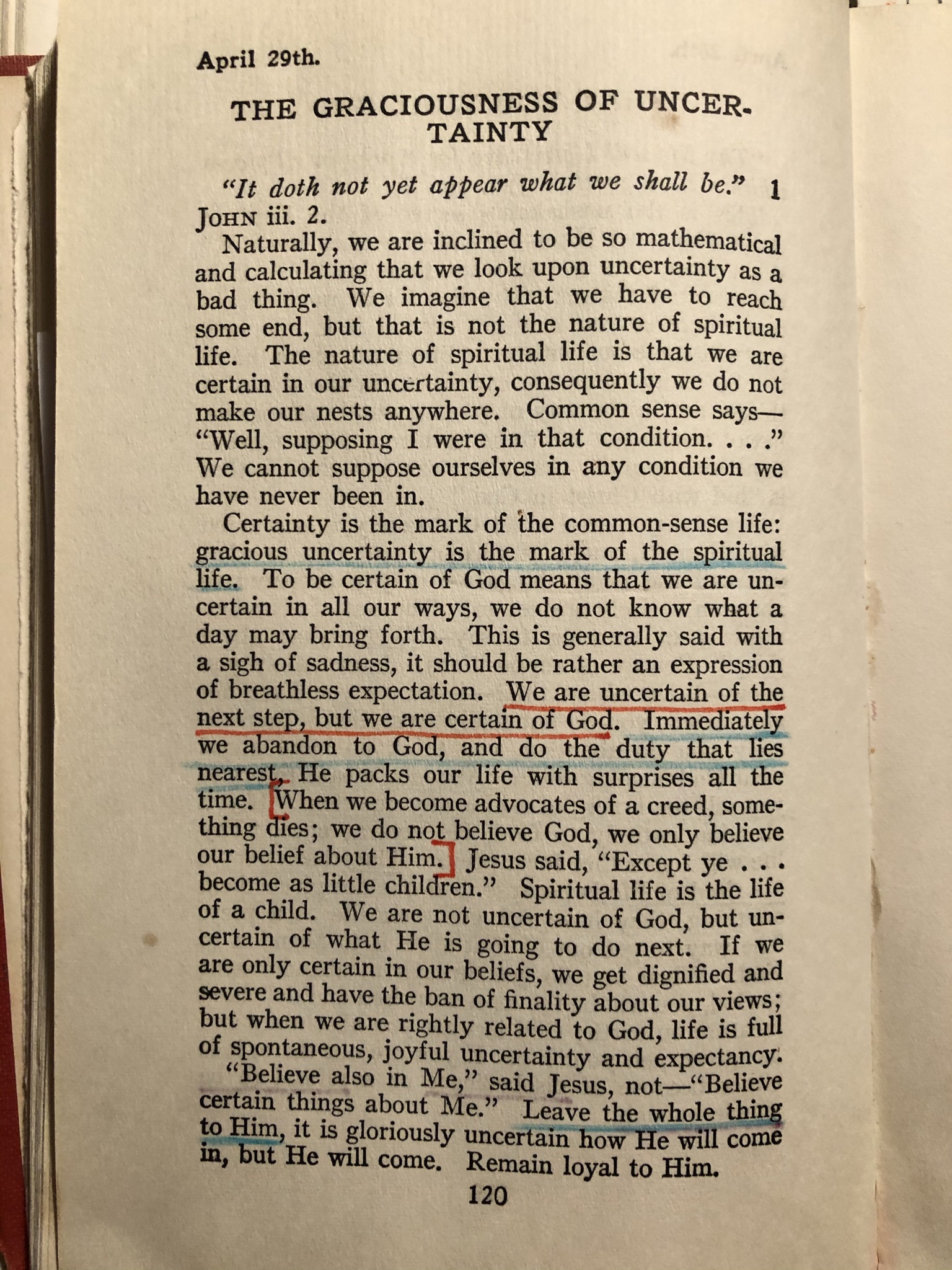
    Naturally, we are inclined to be so mathematical and calculating that we look upon uncertainty as a bad thing. We imagine that we have to reach some end, but that is not the nature of spiritual life. The nature of spiritual life is that we are certain in our uncertainty, consequently we do not make our nests anywhere. Common sense says--"Well, supposing I were in that condition. . . ." We cannot suppose ourselves in any condition we have never been in.

    Certainty is the mark of the common-sense life: gracious uncertainty is the mark of the spiritual life. To be certain of God means that we are uncertain in all our ways, we do not know what a day may bring forth. This is generally said with a sigh of sadness, it should be rather an expression of breathless expectation. We are uncertain of the next step, but we are certain of God. Immediately we abandon to God, and do the duty that lies nearest. He packs our life with surprises all the time. [When we become advocates of a creed, something dies; we do not believe God, we only believe our belief about Him.Jesus said, "Except ye . . . become as little children. (Matthew 18:3)" Spiritual life is the life of a child. We are not uncertain of God, but uncertain of what He is going to do next. If we are only certain in our beliefs, we get dignified and serve and have the ban of finality about our views; but when we are rightly related to God, life is full of spontaneous, joyful uncertainty and expectancy.
 
    "Believe also in Me, (John 14:1)" said Jesus, not--"Believe certain things about Me." Leave the whole thing to Him, it is gloriously uncertain how He will come in, but He will come. Remain loyal to Him.

- From Oswald Chambers, "My Utmost for His Highest" - Classic Edition

Highlights and Underlines are courtesy of Mom from her print edition.

My thoughts
There can be grace in not knowing what happens next. I like certainty. I like a plan. I like a schedule. I like routine. Those are all certainties. But is there room in my life for uncertainty? Also, in my life and the way I define doctrine and truth and thinking I know who God is, I think I almost be careful. I don't want to be a person that says I have it all figured out. I want to remain surprised by Him and what He is teaching me each step of the way. 


Thursday, January 24, 2019

Matthew 19:1-9 - Reading the Bible Holistically

Matthew 19:1-9

1 When Jesus had finished these words, He departed from Galilee and came into the region of Judea beyond the Jordan; 2 and large crowds followed Him, and He healed them there. 3 Some Pharisees came to Jesus, testing Him and asking, “Is it lawful for a man to divorce his wife for any reason at all?” 4 And He answered and said, “Have you not read that He who created them from the beginning made them male and female, 5 and said, ‘For this reason a man shall leave his father and mother and be joined to his wife, and the two shall become one flesh’? 6 So they are no longer two, but one flesh. What therefore God has joined together, let no man separate.”7 They *said to Him, “Why then did Moses command to give her a certificate of divorce and send her away?” 8 He *said to them, “Because of your hardness of heart Moses permitted you to divorce your wives; but from the beginning it has not been this way. 9 And I say to you, whoever divorces his wife, except for immorality, and marries another woman commits adultery.”

Message: Reading the Bible Holistically

Time: The date of Matthew's composition is anywhere from 55-60 AD probably in Antioch of Syria. The writing is most likely to the Jews. His purpose was to show them that Jesus of Nazareth was the expected messiah and both his genealogy and his resurrection were legitimate proofs of this.

What the Lord is Saying:

I need to be careful about how I read the Word of God each day. I thank you that it illumines my path and as I seek nourishment in it each day, it delivers me closer to Jesus and following God. I am enjoying this understanding of Scripture and the different literary styles being used. It is like an English lesson with the Bible. I learned yesterday to make sure I let the explicit meaning of passages define those that may be more implicit. In essence, scripture interprets scripture or scripture defines scripture. The Latin phrase Scriptura sacra sui ipsius interpres means sacred scripture is its own interpreter.

As I read and understand these words of Scripture, as I walk in them and see that they are a light to my path I conclude that God has inspired them. Paul wrote those words that All Scripture is inspired by God. But, I am still piecing together what He meant my All Scripture at that time. Today I can say that this means the canon of the Bible. I Corinthians 14:33 stated explicitly that God is not of confusion but of peace. This tells me that his inspired word does not contradict itself and I must be careful then about it is interpreted. God would not teach one thing in one passage and then contradict that teaching in another passage.

Take these 2 passages - Deuteronomy 24:1-4 and Matthew 19:1-9 that spoke speak of divorce. In Deuteronomy it states that When a man takes a wife and marries her, and it happens that she finds no favor in his eyes because he has found some indecency in her he writes her a certificate of divorce. In the first century, rabbi Hillel embraced the idea that any time any situation arises in which there are irreconcilable differences then a man is permitted to divorce his wife.

Jesus states here in Matthew 19 - He *said to them, “Because of your hardness of heart Moses permitted you to divorce your wives; but from the beginning it has not been this way. And I say to you, whoever divorces his wife, except for immorality, and marries another woman commits adultery.”

I think in Moses's day and in the day of Jesus there was an issue of the hardness of people's hearts on this issue. People are bent towards divorce being an acceptable practice; this was true thousands of years ago and is true today.  Moses and Jesus both come back to the issue of God's plan is for people to marry and not divorce, but both provide their own allowances. We should be focused on the standard and not the exception. But since exceptions occur, we want to make sure we are still on the same playing field as the original expectation. Yet, I am not sure we are. But, I am also not sure any of us are on any issue. I think when we start talking exceptions, Jesus is saying that we need to not do what was often done in the time of Moses and afterwards and that is allow for multiple reasons. Jesus is more strict in stating it is only to be about sexual immorality. Man took a word like uncleanness in Deuteronomy and made it to mean many different things. People then focused on the idea that they could get out of a relationship. The union of man and woman is to be upheld. It is interesting that people looked for the way out and somewhat ignored the consequences.

I think this is what is meant by reading Scripture Holistically - to read all of Scripture and think about the context of each writer. On this issue we focus on the fact that Jesus wants commitments to remain, if at all possible, but if a divorce occurs it needs to be rare. Our divorce rates have improved but mostly because people have stopped getting married.

Promise: We need to read scripture in its context. I need to be a entire-Bible or whole-Bible Christian. I must diligently study all that God has revealed.

Prayer: Lord, help me with the understanding of Your Words. I need Your help.


Note: I follow the readings from the Tabletalk Magazine devotional, though I am a little behind and working through 2017 devotionals. 2017 is a study of key biblical doctrines with February being about the doctrine of revelation and the various aspects of the doctrine of Scripture that sola Scriptura seeks to preserve.


Wednesday, January 23, 2019

I Corinthians 10:1-11 - Explicit and Implicit Teaching

I Corinthians 10:1-11
1 For I do not want you to be unaware, brethren, that our fathers were all under the cloud and all passed through the sea; 2 and all were baptized into Moses in the cloud and in the sea; 3 and all ate the same spiritual food; 4 and all drank the same spiritual drink, for they were drinking from a spiritual rock which followed them; and the rock was Christ. 5 Nevertheless, with most of them God was not well-pleased; for they were laid low in the wilderness.
6 Now these things happened as examples for us, so that we would not crave evil things as they also craved. 7 Do not be idolaters, as some of them were; as it is written, “The people sat down to eat and drink, and stood up to play.” 8 Nor let us act immorally, as some of them did, and twenty-three thousand fell in one day. 9 Nor let us try the Lord, as some of them did, and were destroyed by the serpents. 10 Nor grumble, as some of them did, and were destroyed by the destroyer.11 Now these things happened to them as an example, and they were written for our instruction, upon whom the ends of the ages have come.

Message: Explicit and Implicit Teaching

Time: This epistle was written to the church that resided in Corinth of Achaia. First Corinthians is a response to a letter that Paul received from the Corinthian church, and that letter was probably a response to another of Paul's letters. This letter was composed in Ephesus around AD 54-55, and such topics as division, sexual immorality, lawsuits, marriage, Christian liberty, order of worship, and the resurrection are covered in this epistle.

What the Lord is Saying:

I continue to examine the different forms of literature that we have in our Bible. The Bible is the Word of God. It is God's special revelation to His people and it is the final revelation. The books that we have of the Canon are complete. This Word equips us to do every good work and apply every good thing in our lives. We can trust it. It is to be interpreted literally, but we also realize that there are different language types it has. There are non-literal ways lie phenomenological which describes things the way they appear, like the sun stood still and anthropomorphic language which describes God as having human attributes, like fingers and hands, though he is a spirit. Personification gives personal characteristics to impersonal entities like trees clapping their hands and mountains singing. Hyperbole exaggerates to make a point as the story of the mustard seed begins with this tiny seed and then grows so people can sit in it. Metaphor is a very common one to use a word for one thing that is meant for something else, like Jesus saying I am the door or the light.

All of this forms helps us to better understand what we are reading. The goal is to interpret texts correctly as religions have been started based upon interpretation and many of the different belief systems focus on different ways to interpret. Thus, as we study each passage it is the explicit, direct teaching of the passage that must control our interpretation of that passage.

By explicit instruction, we mean teaching where the instructor clearly outlines what the learning goals are for the reader, and offers clear, unambiguous explanations of the skills and information structures they are presenting. The text referenced here, I Corinthians 10 is an example of explicit teaching as Paul describes things in order that we would not crave evil things. He says Do not be idolaters...Nor let us act immorally...Nor let us try the Lord...nor grumble. These commandments are clear do's and don't in our Bible, and thus the teaching is explicit.

By implicit instruction, we refer to teaching where the instructor does not outline such goals or make such explanations overtly, but rather simply presents the information or problem to the student and allows the student to make their own conclusions and create their own conceptual structures and assimilate the information in the way that makes the most sense to them. An example of this from Scripture would be the telling of the resurrection of Jesus in the Gospels. All four gospels mentions this miracle that occurred - the presence of angels, a heavy stoned rolled away, the appearance of Jesus. None of the Gospels state that God raised Jesus from the dead but this is a natural conclusion. The doctrine of the Trinity would be another example of implicit instruction. Nowhere is that term used in scripture, but we have the Father, Jesus, and the Spirit all with the same God-like attributes. Thus, the instruction provides to us the conclusion of the three persons of God. 

Exodus 32:14 says that the Lord changed His mind about the harm which He said He would do to His people. Now did the Lord really change His mind? Numbers 23:19 says - “God is not a man, that He should lie, Nor a son of man, that He should repent; Has He said, and will He not do it? Or has He spoken, and will He not make it good? So here Numbers says that God does not lie, so how could he change his mind? Numbers 23:19 is explicit teaching. Thus, the description in Exodus 32:14 of God changing his mind is anthropomorphic or giving us human attributes. God knew the plan and to us the appearance was that he changed his mind, but He knew what He would do all along. He does not change His mind like we change ours. 

Thus it is important to allow the explicit passages to help define the meaning of the implicit ones. Thus, the explicit teaching of Numbers 23:19 helps guide our learning of other scriptures. This is an important distinction where we need to understand the way the Bible is being written. 

Promise: It is common for belief systems to take implicit teachings and make them explicit but these explicit teachings contradict other teachings. If there are contradictions in scripture then our beliefs are shallow and we cannot believe anything it says. 

Prayer: Lord, again, thank you for this understanding. You are illuminating my understanding of Scripture. You are providing me the different language types in scripture that help shed light on the reading and understand of Your word. You are a great God. You never change. Help others to understand this teaching so that it can illuminate our understanding of You.


Note: I follow the readings from the Tabletalk Magazine devotional, though I am a little behind and working through 2017 devotionals. 2017 is a study of key biblical doctrines with February being about the doctrine of revelation and the various aspects of the doctrine of Scripture that sola Scriptura seeks to preserve.