Saturday, March 28, 2026
2 Samuel 22:32-51 - Kindness to the Lord's Anointed
Saturday, May 25, 2024
John 17:10-13 - The Efficacious Prayers of Christ
Friday, May 24, 2024
John 17:9 - The Focused Prayers of Christ
- If the Father has given them to Jesus, then these disciple were previously the Father's before they were given to the Son. -- Interesting idea here of all that is the Father's is the Son's. But are all people of the Father? Or only these disciples? Not the world as is mentioned.
- Jesus did not only pray for the disciples as in verse 20 to 26 He will pray for the world, but it will be interesting to read those words and see if these words are more exclusive to those God knows.
Saturday, October 7, 2023
John 6:16-21 - Walking on the Sea of Galilee
What the Lord is Saying: So in the previous verse Jesus had retired to the mountain after the people were thinking that he was their prophet, their long awaited one who will change the tide of everything politically, but Jesus instead retreats, back to where he and the disciples were at, in the mountains.
Wednesday, March 15, 2023
Leviticus 8 - The Old Covenant Priesthood
Leviticus 8, specifically verses 12 and 13 - "Then he poured some of the anointing oil on Aaron's head and anointed him, to consecrate him. Next Moses had Aaron's sons come near and clothed them with tunics, and girded them with sashes, and bound caps on them, just as the Lord had commanded Moses."
Message: The Old Covenant Priesthood
Time: There is sufficient evidence that Moses penned Exodus and Leviticus including references to Leviticus by New Testament authors. Its name means "pertaining to the Levites" and its purpose was to instruct the Israelites on right living and proper worship. The most likely time for this is 1446 BC. The book communicates that receiving God’s forgiveness and acceptance should be followed by holy living and spiritual growth.
What the Lord is Saying: Our fundamental need of having a right relationship to our Creator -
- Forgiveness of sins (Romans 3:21-26)
- Imputation of Christ's righteousness; justification (Romans 3:21-26)
- Believe on the name of the Lord Jesus Christ (Acts 16:31)
- The Holy Spirit to regenerate us (John 3:1-8)
Our pathway to achieve these is having a mediator in order that we will be rightly related to God, approved by Him and accepted into His kingdom. It in Jesus that our sins are forgiven, that we are justified or made right with God and the Holy Spirit, who is God, regenerates us.
In the Old Testament, the Messiah was anticipated and people in their daily lives saw a type or foreshadowing of the Messiah through the old covenant priest. The priest is mentioned often in the Old Testament as one who is set apart for service. The priest is commissioned via the anointing of oil, through offering sacrifice and even by receiving special clothing. Perhaps baptism, confession and being born again sets us apart today in these ways. The priest must be set apart because only he was able to enter the inner parts of the tabernacle to offer sacrifices to cover people's sins. The priest was the go-between man and God. And only the high priest could enter the holy of holies and once a year, the day of atonement.
The priest enabled the people to worship the Lord. And yet there was still this separation as ordinary people could not enter the Holy of Holies and the service of the priests was distinct or separate from other people's service to the Lord.
Yet, it is important to recognize this history. This reminds me the importance of sin and it's seriousness in our lives and yet how we do not have the means on our own to be made right with God. We need someone else to provide this for us. In the old covenant, it was provided by the priest through sacrifices and entering into the holiest presence of God. Throughout the history man has not been able to absolve his own sins. He has needed someone else to do this.
Summary: God has always provided a substitute and a mediator between God and man to reconcile us (Priests, Jesus). Man sins. God provides the way for righteousness.
Promise: We have no need for earthly priests today. Christ is our mediator. We study the old covenant revelation to better understand the work of Christ.
Prayer: O Lord, thank you for the consistency of Your Word and showing me the place of a mediator you have always provided to remove sin and make me righteous. It was a priest in Old Covenant time and it is Jesus today and for always. There is nothing that man does to make himself holy and yet you want us to be a people that obeys you because You are a God to be obeyed. You are Holy and we need to rightly obey You. Thank you for these lessons and reminders from your Word.
Tuesday, May 4, 2021
My Utmost for His Highest - May 4th - Vicarious Intercession
Therefore, brethren, since we have confidence to enter the holy place by the blood of Jesus. - Hebrews 10:19
Beware of imagining that intercession means bringing our personal sympathies into the presence of God and demanding that He does what we ask. Our approach to God is due entirely to the vicarious identification of our Lord with sin. We have "boldness to enter into the holiest by the blood of Jesus."
Spiritual stubbornness is the most effectual hindrance to intercession, because it is based on sympathy with that in ourselves and in others that we do not think needs atoning for. We have the notion that there are certain right and virtuous things in us which do not need to be based on the Atonement, and just in the domain of "stodge" that is produced by this idea we cannot intercede. We do not identify ourselves with God's interests in others, we get petulant with God; we are always ready with our own ideas, and intercession becomes the glorification of our own natural sympathies. We have to realize that the identification of Jesus with sin means the radical alteration of all our sympathies. Vicarious intercession means that we deliberately substitute God's interests in others for our natural sympathy with them.Am I stubborn or substituted? Petted or perfect in my relationship to God? Sulky or spiritual? Determined to have my own way or determined to be identified with Him?
Monday, May 3, 2021
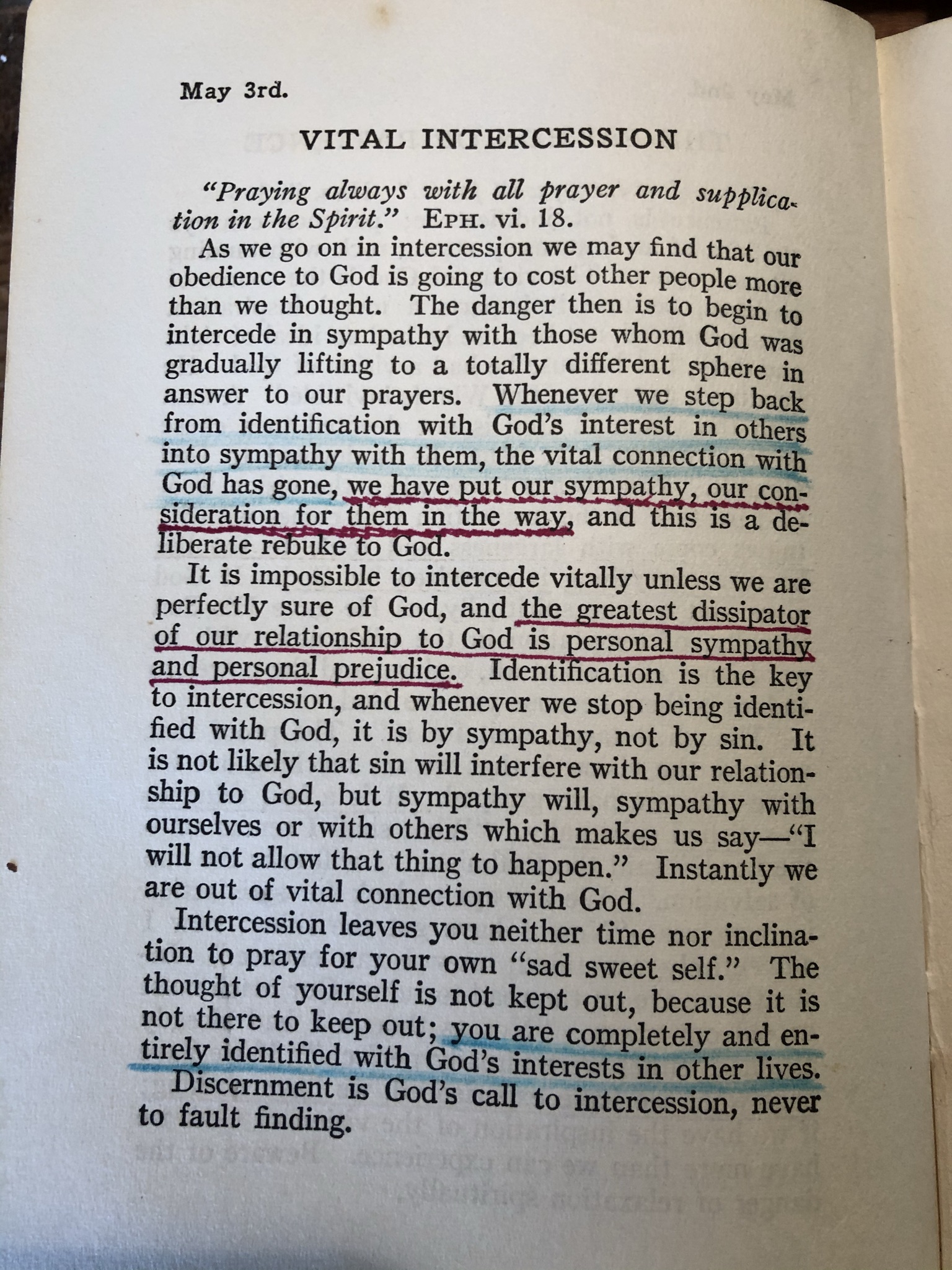
My Utmost for His Highest - May 3rd - Vital Intercession
Thursday, April 1, 2021
My Utmost for His Highest - April 1st - Heartiness v. Heartlessness Towards Others
who is the one who condemns? Christ Jesus is He who died, but rather, was raised, who is at the right hand of God, who also intercedes for us. - Romans 8:34
and He who searches the hearts knows what the mind of the Spirit is, because He intercedes for the saints according to the will of God. - Romans 8:27
Do we need any more argument than this to become intercessors--that Christ "ever liveth to make intercession;" that the Holy Spirit "maketh intercessioin for the saints"? Are we living in such a vital relationship to our fellow men that we do the work of intercession as the Spirit-taught children of God? Begin with the circumstances we are in --our homes, our business, our country, the present crisis as it touches us and others--are these things crushing us? Are they badgering us out of the presence of God and leaving us no time for worship? Then let us call a halt, and get into such living relationship with God that our relationship to others may be maintained on the line of intercession whereby God works His marvels.Beware of outstripping God by your very longing to do His will. We run ahead of Him in a thousand and one activities, consequently we get so burdened with persons and with difficulties that we do not worship God, we do not intercede. If once the burden and the pressure come upon us and we are not in the worshipping attitude, it will produce not only hardness toward God but despair in our own souls. God continually introduces us to people for who we have no affinity, and unless we are worshipping God, the most natural thing to do is to treat them heartlessly, to give them a text like the jab of a spear, or leave them with a rapped-out counsel of God and go. A heartless Christian must be a terrible grief to our Lord.
Are we in the direct line of the intercession of our Lord and of the Holy Spirit?
Oswald Chambers - From My Utmost for His Highest Classic Edition
Wednesday, March 31, 2021
My Utmost for His Highest - March 31st - Heedfulness v Hypocrisy In Ourselves
If anyone sees his brother or sister committing a sin not leading to death, he shall ask and God will, for him, give life to those who commit sin not leading to death. There is sin leading to death; I am not saying that he should ask about that. - I John 5:16
If we are not heedful of the way the Spirit of God works in us, we will become spiritual hypocrites. We see where other folks are failing, and we turn our discernment into the gibe of criticism instead of into intercession on their behalf. The revelation is made to us not through the acuteness of our minds, but by the direct penetration of the Spirit of God, and if we are not heedful of the source of the revelation, we will become criticizing centres and forget that God says--". . . he shall ask, and He shall give him life for them that sin not unto death." Take care lest you play the hypocrite by spending all your time trying to get others right before you worship God yourself.One of the subtlest burdens God ever puts on us as saints is this burden of discernment concerning other souls. He reveals things in order that we may take the burden of these souls before Him and form the mind of Christ about them, and as we intercede on His line, God says He will give us "life for them that sin not unto death." It is not that we bring God into touch with our minds, but that we rouse ourselves until God is able to convey His mind to us about the one for whom we intercede.
Is Jesus Christ seeing of the travail of His soul in us? He cannot unless we are so identified with Himself that we are roused up to get His view about the people for whom we pray. May we learn to intercede so whole-heartedly that Jesus Christ will be abundantly satisfied with us as intercessors.
Tuesday, March 30, 2021
My Utmost for His Highest - March 30th - Holiness v. Hardness Towards God
Then His own arm brought salvation to Him,
And His righteousness upheld Him. - Isaiah 59:16
Thursday, September 17, 2020
Hebrews 2:17 - Christ Our Priest
Hebrews 2:17
Therefore, He had to be made like His brethren in all things, so that He might become a merciful and faithful high priest in things pertaining to God, to make propitiation for the sins of the people.
Message: Christ Our Priest
Time: The authorship of this book is shrouded in mystery, though its Jewish composition can still nail down its authorship to AD 64-69, as the book does not mention the destruction of the temple in AD 70. It has references to Jewish customs and the Old Testament, so most likely was sent to a Jewish community.
What the Lord is Saying:
Charles Swindoll states that "Hebrews clearly lays out the present priestly ministry of Christ in the life of the believer. Jesus is both the divine Son of God and completely human, and in His priestly role He clears the way for human beings to approach the Father in heaven through prayer."
Only chapter 1, 10, 11, and 13 do not mention this role of priest of Jesus in Hebrews.
My study so far has been of Christ Alone as the one who saves us. I've looked at His attributes, His work or obedience, and now have shifted to His titles - as our Prophet and now our Priest. The priest is a title that meant a great deal to the Jewish community for a high priest acted as a representative on earth of God. They brought sacrifices to cover sin and it is interesting the Catholic Church carried on this role in similar ways. The Day of Atonement was one of the most significant days as annually it represented the cleansing of people - to maintain the covenant relationship between the Israelites and the Lord.
Even up to the time of the Reformation this office of Priest was one of the stark identifiers in what Martin Luther saw as a problem with the Roman Catholic church - that man needed a go-between to get to God or be absolved of sin. What is a mystery is how the priests role continues to institute or give the idea that the priest must receive penance and be the intercessor between God and Man. For me, God remains a mystery in many people's lives so they are looking for any type of authority to help them understand God and so the Priest becomes that authority and what we do then is listen to whatever the person has to say.
The Westminster Shorter Catechism written in 1646 and 1647 states, "Christ executeth the office of a priest, in his once offering up of himself a sacrifice to satisfy divine justice, and reconcile us to God; and in making continual intercession for us (WSC 25)." In today's text, Jesus is made like his brothers in all things, so God becomes a man and lives as a man. So that he might become a merciful and high priest - the problem with the continuous role of priest is the priest offers something temporary. Old covenant priests repeated their sacrifices annually, by replacing the penalty of sin with the blood of an animal. The practice was to retrieve an unblemished animal, so to find an animal that is as perfect as possible and this blood atoned for sin. The Messiah is one that releases people from captivity. Man is captive to his flesh and because of this will always be imperfect. Jesus as Messiah releases man by offering Himself and offers a perfect version of man - one without sin. Thus, Jesus is our High Priest. I'm not sure people think that the priest today is meant to replace Jesus, but it gives that impression. Why would we continue to use someone like a priest that is not all sufficient?
Promise: Jesus cannot fail to save the elect. He offers true atonement for sin. Jesus through His sacrifice regained for men and women a relationship with God.
Prayer: Lord, it saddens me to see how you are misunderstood in our world, but I suppose this is what happens when eyes are blinded to the truth and it is apparent. It is hard to be part of a remnant at times for the majority is what we often want to be about. But the reality is, as we work and live in our world, we as Christians are a minority and what we think and believe about life and living and salvation is somewhat unique. I pray that the message of the Gospel would penetrate people's lives and for those you place in my place, you would help me be a conduit of information for the truth of who You are. Thank you for using me in the way you have, for even using this blog to help communicate to others. Help me to continue to be a light to those in need. Be glorified always.
Note: I follow the readings from the Tabletalk Magazine devotional, though I am a little behind and working through 2017 devotionals. 2017 is a study of key biblical doctrines celebrating the 500th year of the Reformation. The month of May is about solus Christus - Christ Alone; April was about salvation by grace alone; March about the sovereign providence of God; February was about the doctrine of revelation and the various aspects of the doctrine of Scripture that sola Scriptura seeks to preserve; January was about the doctrine of God.
- The Divine Nature of Christ, The Human Nature of Christ, Jesus the Last Adam, Jesus the True Israel, Jesus the Messiah, Obedience in Childhood, Obedience in Baptism, Obedience in Temptation, Obedience under the Law, Obedience in Suffering, Christ Our Prophet, Christ the Priest
Friday, November 15, 2019
My Utmost for His Highest - November 15 - What Is That to Thee?
One of our severest lessons comes from the stubborn refusal to see that we must not interfere in other people’s lives. It takes a long time to realize the danger of being an amateur providence, that is, interfering with God’s order for others. You see a certain person suffering, and you say — “He shall not suffer, and I will see that he does not.” You put your hand straight in front of God’s permissive will to prevent it, and God says — “What is that to thee?” If there is stagnation spiritually, never allow it to go on, but get into God’s presence and find out the reason for it. Possibly you will find it is because you have been interfering in the life of another; proposing things you had no right to propose; advising when you had no right to advise. When you do have to give advice to another, God will advise through you with the direct understanding of His Spirit; your part is to be so rightly related to God that His discernment comes through you all the time for the blessing of another soul.
Sunday, January 27, 2019
I Corinthians 2:10b-16 - Illumining Scripture
For the Spirit searches all things, even the depths of God. 11 For who among men knows the thoughts of a man except the spirit of the man which is in him? Even so the thoughts of God no one knows except the Spirit of God. 12 Now we have received, not the spirit of the world, but the Spirit who is from God, so that we may know the things freely given to us by God, 13 which things we also speak, not in words taught by human wisdom, but in those taught by the Spirit, combining spiritual thoughts with spiritual words.
14 But a natural man does not accept the things of the Spirit of God, for they are foolishness to him; and he cannot understand them, because they are spiritually appraised. 15 But he who is spiritual appraises all things, yet he himself is appraised by no one. FOR WHO HAS KNOWN THE MIND OF THE LORD, THAT HE WILL INSTRUCT HIM? But we have the mind of Christ.
Message: Illumining Scripture
Time: This epistle was written to the church that resided in Corinth of Achaia. First Corinthians is a response to a letter that Paul received from the Corinthian church, and that letter was probably a response to another of Paul's letters. This letter was composed in Ephesus around AD 54-55, and such topics as division, sexual immorality, lawsuits, marriage, Christian liberty, order of worship, and the resurrection are covered in this epistle.
What the Lord is Saying:
This is the last day in this study of Sola scriptura - that Scripture is the sole authority of our lives. There are natural revelations in this world - creation which testifies about God but doesn't necessarily save man. But hopefully it brings us to that knowledge. God speaks through people, through dreams, through events, through anything he desires. But his final revelation of who He is and His salvation is through Jesus and was revealed to us in His holy word. And so All scripture is inspired by Him. All scripture is breathed out from him. It provides us every thing that we need for life - everything. It is complete. It cannot be broken. It never fails. Yet he spoke through fallible men, speaking in a unique way through them, through their personalities. And they can still fail. But the word that we now of a scripture is Sola Scriptura - infallible, inerrant. So it is clear. It should be clear. It is meant to be clear in its meaning. The words itself have been set apart as Scripture through a canon process. As God inspired the writers to write, he also has confirmed the text that we consider to be All Scripture. It ended with the witnesses of the resurrection and Jesus testimony. We need to make sure we rightly handle this truth in our lives. We need to interpret it correctly. It is a literal interpretation and yet there are different ways it is spoken - in non-literal language such as phenomenological and anthropomorphic, through different genre's like prophecy, epistles, law, prophets, parables, apostles and in English styles such as personification, hyperbole, and metaphors. There is explicit and implicit teachings. We interpret the Bible with the Bible. If two passages seem to conflict we must realize they don't, they can't. Understand the context. Yet talk to each other through this process. Help one another to understand it better.
And today, I am reminded that all the while, realize that we are not alone as the Holy Spirit is with us illuminating the words. The Holy Spirit is here. Paul instructs us explicitly in this today. He tells us clearly that the thoughts of God no one knows except the Spirit of God. We have the Spirit in us, illuminating His words to us, helping us understand what we need to know. This Spirit wants us to freely now the things of God. It is like I have to figure out how to filter out everything that is not God in my life, so that I can see Him, and what He is to teach me and have me learn -- so that we may know the things freely given to us by God. I am to take those spiritual thoughts and then communicate with spiritual words. It is like this is to be my language but according to my personality.
But this doesn't mean that natural man or unbelievers cannot know what scripture is saying - just that they lack the illumination of the text and what it means for salvation or come to saving faith. For them it is a textbook. That's what I've always thought of the JW's and the LDS - this book is a textbook to them. And most people see it as a life manual only. They see it as a handbook to living life now and sometimes even in the next life. But, my life in Christ is everything to me. It is to definite my thoughts and then my words. The Spirit tells me what I am to know about God, my creator, my sustenance, and therefore my life. It is not a duty in order to get more people in a church and please the church - it is me with God in this life. It is living with the mind of Christ.
If the Spirit is in me, it is in others and so I can listen to their words.
Promise: In all of my study of Scripture, I must never forget my need of the Holy Spirit's assistance. As I read, I need to pray that the Spirit will illuminate that reading and give me understanding so that I can then apply it. I am not simply a bucket that is at church or in a study to fill up a bucket, but I am to be a hose, spraying out to everyone in my path.
Prayer: O God, there is power in your name, in You, and You are equipping me even now through the Words and Work of the Holy Spirit in my life. I trust in you. I do not trust in me. I want your words thoughts to be my thoughts and your words my words. Thank you for living in me and illuminating me. Thank you for entrusting me with You and providing me all that I need. Clear out the gutter and the garbage in me. Train me according to your godliness. I depend on You, Jesus.
Note: I follow the readings from the Tabletalk Magazine devotional, though I am a little behind and working through 2017 devotionals. 2017 is a study of key biblical doctrines with February being about the doctrine of revelation and the various aspects of the doctrine of Scripture that sola Scriptura seeks to preserve.
Tuesday, June 5, 2018
Mark 8:22-26 - The Blind Man at Bethsaida
22 And they *came to Bethsaida. And they *brought a blind man to Jesus and *implored Him to touch him. 23 Taking the blind man by the hand, He brought him out of the village; and after spitting on his eyes and laying His hands on him, He asked him, “Do you see anything?” 24 And he looked up and said, “I see men, for I see them like trees, walking around.” 25 Then again He laid His hands on his eyes; and he looked intently and was restored, and began to see everything clearly. 26 And He sent him to his home, saying, “Do not even enter the village.”
Message: The Blind Man at Bethsaida
Time: Mark's personal connection with Peter gave him the source material for this book. This book was composed probably between AD 57 and AD 59. It's a book that is on the move, leading to the cross. 39 times is the word 'immediately' used. Mark reveals Jesus as God's servant, reaching into the lives of people and effecting physical and circumstantial change.
What the Lord is Saying:
Preface: After feeding 4,000, the disciples still talk among themselves when they get in the boat and realize they have no food. Jesus simply wants them to look to Him. He is there provider. He continues to show them his hand of providence in all things, they still struggle with anxiety and worry.
Now they (Jesus and the disciples) are in Bethsaida. Jesus was in the district of Dalmanutha, near Magdallan, just west of the Sea of Galilee. Bethsaida is north. There is not much distance between the two places. The sea of Galilee is 8 miles wide. My guess is that it is about 8 miles between the cities, perhaps one could get there in 1 day.
As he arrives, a blind man is brought to Jesus and they implored Him to touch him. The blind man didn't come to Jesus on his own, but was brought to him. He brought him out of the village. It is thought that the healing occurred outside of the City because Jesus was concerned about the town's unbelief and he would refuse to perform miracles before those who continued to not believe or accept His teachings. Jesus is ready to answer questions of anyone that asks, and yet answering people's questions is not his mission. He is on the scene to change hearts and those people's hearts just want to question, not necessarily be changed.
There has been a remark here that this particular healing is unique because of the stages. One, Taking the blind man by the hand. Two, He brought him out of the village. Three, spitting on his eyes. Fourth, laying His hands on him. It isn't immediate, but progressive. In other instances, by now, the person would be completely restored and yet, here, the person is not. As after doing all of this the man's sight was not fixed: “I see men, for I see them like trees, walking around.” He has been spit on by Jesus and Jesus has laid his hands on him. Previously, a woman touching the cloak of Jesus brought about immediate healing. So Jesus does not embody a transformation. So, it isn't that all you have to do is touch him and you are saved, but Jesus has something to do with the healing, in his time.
There is a moment when Jesus decides to heal and sometimes he doesn't decide. Sometimes I wish the Gospel had a story about someone coming to Jesus and him not healing the person. Because it happens in life. Not everyone is healed. Some people implore him but are still not healed. And this is a hard thing at times to reconcile in our lives. And people not getting what they want, often results in no belief. People expect everyone to be viewed equally. But, in this lesson, perhaps is the reminder that Jesus makes the decision.
It states again He laid His hands on his eyes; and he looked intently and was restored, and began to see everything clearly. Why did this healing need two touches? It didn't, but it seems Jesus was communicating something more here, perhaps to this man, perhaps to us, perhaps even to the disciples.
Also, the faith of the blind man is never mentioned here.
Summary: Jesus heals a blind man, outside of the City of Bethsaida, a place of unbelief, so he heals outside of those that would question him. He heals with progression, after placing his hand on the blind man two times. In the same way, we need to implore Jesus repeatedly.
Promise: God does not always do what we ask, when we ask; he has reasons. Healing can be a process. It can take time. It may not happen at all or in the manner we think it should.
Prayer: Lord, keep teaching me through these readings. As I read about the lessons you were teaching people at the time, you still can have a lesson for me today. I admit, at times, I do not understand the way you work, the suffering that people experience, the healing of some, but not of others. But, I am still a follower. My following isn't about you doing what I want, for you show me that I can trust You no matter what.
Monday, February 12, 2018
Mark 5:21-24a - Jairus Comes to Jesus
21 When Jesus had crossed over again in the boat to the other side, a large crowd gathered around Him; and so He stayed by the seashore.22 One of the synagogue officials named Jairus *came up, and on seeing Him, *fell at His feet 23 and *implored Him earnestly, saying, “My little daughter is at the point of death; please come and lay Your hands on her, so that she will get well and live.” 24a And He went off with him;
Message: Jairus Comes to Jesus
Time: Mark's personal connection with Peter gave him the source material for this book. This book was composed probably between AD 57 and AD 59. It's a book that is on the move, leading to the cross. 39 times is the word 'immediately' used. Mark reveals Jesus as God's servant, reaching into the lives of people and effecting physical and circumstantial change.
What the Lord is Saying:
Jesus has left the Geradene side of the lake (sea of Galilee) and now come back to the west side, at Capernaum and a large crowd gathered around Him; people were waiting for him to come back, anticipating his arrival. Thus, Jesus is getting more popular. "Christ ennobled Bethlehem by his birth, Nazareth by his education, and Jerusalem By his death, so he honored Capernaum by making it his ordinary residence, and the focus, so to speak, of his preaching and miracles. (Pulpit Commentary)."
One of the synagogue officials named Jairus came up, and on seeing Him, fell at His feet. Synagogue officials were Jewish layman (not full-time ministers) in charge of maintaining the building and organizing, such as the schedule of synagogue services; though there could have been more than one of these per synagogue.
Jairus implored Him earnestly, saying, “My little daughter is at the point of death; please come and lay Your hands on her, so that she will get well and live.” Matthew remarked that she was already dead in his account, yet later in Mark (v. 35) was the declaration that the daughter had died before the Lord could get to her. As a reminder, this account given to Mark probably came from Peter. It is possible that Peter knew Jairus or perhaps this stood out from Peter. It's difficult to know the details of these events. What we do know is Jesus went off with him. Jesus has compassion and concern and he addresses this man's need.
Promise: I can be confident that Jesus will address needs, my needs. He has compassion on specific needs and Mark wants us to know this through these words.
Prayer: Lord, thank you for being personal. Thank you for loving people, all people, and desiring to help people in their time of need. Thank you for the message that we receive from these words that you do care for people and want the best for them. Help us to have confidence in You at all times and in life. You will not always do exactly what we want all the time, but I continue to praise your name. Help others to trust you as well. Draw people closer to you.
Tuesday, May 24, 2016
Psalm 22:16-31 - The Messiah Restored
16 For dogs have surrounded me; a band of evildoers has encompassed me; they pierced my hands and my feet. 17 I can count all my bones. They look, they stare at me; 18 They divide my garments among them, and for my clothing they cast lots. 19 But You, O Lord, be not far off; O You my help, hasten to my assistance. 20 Deliver my soul from the sword, my only life from the power of the dog. 21 Save me from the lion’s mouth; from the horns of the wild oxen You answer me. 22 I will tell of Your name to my brethren; in the midst of the assembly I will praise You. 23 You who fear the Lord, praise Him; All you descendants of Jacob, glorify Him, and stand in awe of Him, all you descendants of Israel. 24 For He has not despised nor abhorred the affliction of the afflicted; nor has He hidden His face from him; But when he cried to Him for help, He heard. 25 From You comes my praise in the great assembly; I shall pay my vows before those who fear Him. 26 The afflicted will eat and be satisfied; Those who seek Him will praise the Lord. Let your heart live forever! 27 All the ends of the earth will remember and turn to the Lord, And all the families of the nations will worship before You.
Message: The Messiah Restored
Time: The psalms were written by many different people across a period of a thousand years in Israel's history. They are thought to have been compiled and put together in their present form by some unknown editor shortly after the captivity ended about 537 B.C.
What the Lord is Saying:
Initial Observations
In my first reading of the first 15 verses, I have remarked the following: The Psalmist is not only feeling hurt, but sort of abandoned by God. He mentions that God is faithful and he knows this because of those that have come before him assure him of this; he also knows this because he was born into love; but he still hurts and he still feels pain. And being a man of faith often brings him ridicule from others as they mock his faith and trust in God.
We come to God open and honestly. In this passage, I feel alone. God is Holy. God has delivered people in the past. I feel like a worm. But I know God sees value in me. God, be not far from me.
I am surrounded by death
Verse 16 is a continuation in thought from verse 11. At this point in this passage, the Psalmist is feeling surrounded by outside sources. And these words continue through verse 18. In reading these verses it does seems to point clearly to the cross that Jesus was on later: 16 For dogs have surrounded me; a band of evildoers has encompassed me; they pierced my hands and my feet. 17 I can count all my bones. They look, they stare at me; 18 They divide my garments among them, and for my clothing they cast lots. It was a horrific scene; the dogs are waiting for a corpse to occur so they can eat the remains; evildoers are rejoicing in the prize they have brought down; his hands are pierced and his feet. He can even count his own bones because he has had so little and he his whole body is trying to just keep himself alive. He has no use to his clothing anymore so they are taking all that is his.
Response: Call on God to intervene
Again, as had been said previously, despite the condition of the Psalmist or the Savior, in this time of need, our response is to turn to God. 19 But You, O Lord, be not far off; O You my help, hasten to my assistance. 20 Deliver my soul from the sword, my only life from the power of the dog. 21 Save me from the lion’s mouth; from the horns of the wild oxen You answer me. Basically, the Lord is near. We are not abandoned by God. Lord, do not be far from you. God, you are my help in my time of need so come to my assistance. Deliver me from that which chooses to take my life and take me away from the dogs that encircle me and from the lion's mouth. You answer me God. He pleads to God; he begs not to man during this time but he begs to God.
When I am in a time of great need, I need to call on God to intervene, not man. I tend to think that the people that will rescue me will be my fellow men/women. I think of that guy in Africa that was asking me for money because in his eyes, if he is going to get money, he is going to get it from a man. Sure, it makes sense, but for him to make it, God is going to have to intervene in someone's life. So, his focus should not be on man, but on God. He should be pleading with God. This is our focus as a Christian. Our confidence and our hope is always in God, not on man. God is the one that changes lives. So take our concerns before Him. I think that is the meaning of Philippians 4:6-7 reminding us to not worry, but pray about everything.
Testify of the Lord's work in my life
The rest of the verses in this chapter, 22-31, is the Psalmist testifying of the Lord before people, before everyone. Is God really on my lips? Is He someone that I give credit to regarding life?
22 I will tell of Your name to my brethren; in the midst of the assembly I will praise You. I will speak your name to my brothers; I will praise you in the assembly. It's not, "Look what I have done" but instead "look what He has done."
23 You who fear the Lord, praise Him; All you descendants of Jacob, glorify Him, and stand in awe of Him, all you descendants of Israel. 24 For He has not despised nor abhorred the affliction of the afflicted; nor has He hidden His face from him; But when he cried to Him for help, He heard. God does not let us down. God hears. Keep reminding people of this.
25 From You comes my praise in the great assembly; I shall pay my vows before those who fear Him. 26 The afflicted will eat and be satisfied; Those who seek Him will praise the Lord. Let your heart live forever! 27 All the ends of the earth will remember and turn to the Lord, And all the families of the nations will worship before You. 28 For the kingdom is the Lord’s and He rules over the nations. 29 All the prosperous of the earth will eat and worship, all those who go down to the dust will bow before Him, Even he who cannot keep his soul alive. 30 Posterity will serve Him; It will be told of the Lord to the coming generation. 31 They will come and will declare His righteousness to a people who will be born, that He has performed it.
Promise: In those moments when all seems against us, in those times, I am to call on God to intervene and testify of His greatness.
Monday, October 13, 2014
Romans 8:33-34 - None Can Condemn
Message: Encouragement, no one can really charge anything against when we are in Christ
Time: This book was probably written between 56 and 57 B.C. Paul was in Greece, probably Corinth when he wrote. It was sent to Gentile believers, but also believers with a strong Jewish element.
What the Lord is Saying:
Review
Starting in verse 26, Paul seems to be offering an encouragement to me and other Christians. Through these verses he is confirming who I am in Christ so that I can rest on these objective (not subjective) promises.
When I struggle in prayer, as I do often, I can be reminded that God is there, providing his Spirit to intercede on my behalf for me. So God is my help in prayer. And even more so I can have the assurance, in verse 28, that He is working everything out in my life for good. He is using everything and working it all together for good.
Why would He do this? Because He chose me, as it says in verse 28, "that I am called according to his purposes." My life therefore is lived for His purposes. He knew me before there was me. He has a purpose in my life and that is to conform me to the image of His son. It is like the Degarmo & Key song, "Perfect Reflection."
Like a perfect reflection of You
In the heart of me
A perfect reflection of You
Is what I want to be
Make my life a portrait like a work of art
A living revelation of Your Heart
He is growing me and working things together in my life so that I will reflect Jesus in a perfect way on this earth and for all time.
When He justified me, He glorified me. So naturally through sanctification, He will make me holy.
I can't help but think that the audience that he is speaking to, these Roman Christians, though they are knee-deep in preaching the gospel, they are also knee-deep in struggles and trials and difficult times because Paul in these words of Romans 8, now specifically, continues to re-affirm that God is on their side. The Spirit is with them. They are chosen. God is for them. Paul speaks to them in many different ways, repeatedly reminding them that God is there, He cares.
No charge against us
Though it feels at times people or events are leveling blows at me, I can rest assure that there is no lasting charge (verse 33) that can be made against me because I am God's elect. This should produce in me all kinds of comfort.
In life, I am so well trained in responding to difficult situations or attacks or charges in an unwholesome manner. I am so quick to react rather than to respond. I want could be slow to anger or slow to react.
Only God condemns
In verse 34, it is God who justifies or it is God who is the one that makes people right and acceptable and true and worthy to receive honor and blessing.then also he is the one who condemns, so please be reminded and hear this, Christian, no one can bring a charge against you.
A God who intercedes for us
It seems that in these last few verses of Romans 8,we have a Father that intercedes for us, Jesus who intercedes for us, the Spirit intercedes for us. We have God in three persons interceding for us. God is once again on our side. We don't need to fret with the struggles that we are experiencing.
Promise For those in Christ, the verdict of righteousness is already occurred and nothing can hurt us.
Sunday, October 5, 2014
Romans 8:26-27 - The Spirit's Intercession
Message: Prayer as it should be
Time: This book was probably written between 56 and 57 B.C. Paul was in Greece, probably Corinth when he wrote. It was sent to Gentile believers, but also believers with a strong Jewish element.
What the Lord is Saying:
Review
It never gets old to review where I've come from so far in this study of Romans. I definitely am loving this study. I've studied Romans before but I don't think I've ever gotten this far into it. I tend to be a starter and not a finisher, so I still have a goal to finish.
Romans 1 continues to be my favorite in all of scripture. I love the introduction Paul makes of this letter in the first 17 verses, proclaiming that it is all about the gospel, not just the letter, but really his life is all about the gospel and proclaiming it. He longs to see the people in Rome. Why? Because they are all about the gospel and making it known.
But then the rest of Romans 1 gives us a heavy dose on the reality of our culture. The reality is our culture has replaced God with, well, basically anything else. And the scariest thing is, "God has given them over" to it. It reminds me of Moses and Pharaoh. God sent Moses to Pharaoh and Pharaoh's heart was hardened. In the first half mentions of the hardening of Pharaoh's heart, it was Pharaoh admitting a hardened heart, but in the last half it was that God had hardened his heart. Same thing in Romans 1. It starts out with people knowing God, but not honoring, not giving thanks, but exchanged God for something else and then it moves to God giving them over to their degrading passions.
So, in my opinion the only way they can come back is if God draws them and this often the result of our fervent praying.
The last half of Romans 1 is really directed toward the guilt of the Gentile, so Paul takes the time to speak of the guilt of the Jew in chapter 2 and 3 through verse 20. It is clear the Law won't save the Jew and the act of circumcision won't save the Jew. No one gets a free pass before God. Paul clearly shows that there is nothing of man's doing that can make him right with God. That is a very hard truth for people to accept.
At the end of chapter 3 is really perhaps a small Gospel presentation which is really kind of fitting. The Gospel is simple. God will make me righteous. Without God interceding I am unrighteous. God intercedes by sending His Son as our redeemer. I receive righteousness by faith apart from any works I may do. It's actually very simple.
Paul then confirms that this is nothing new and Abraham had the same thing happen to him whereby God declared Him righteous and Paul explains this in chapter 4.
What does it mean to be justified? Chapter 5 tells us the benefits. The first one is well understood and received, it is peace. But, the 2nd one is rarely celebrated. We have joy in tribulation. It is out of our sin, our mistakes, our goof-ups and then our trials and tribulations that God is glorified and in our trials as redeemed people our faith is confirmed, validated, and brings us hope in the day of Glory. and the 3rd benefit is I am saved from God's wrath. In Adam, sin spread to all men resulting in death to all. In Christ, redemption is available to all, resulting in eternal life with God.
Chapter 6, 7, and 8 then pose the question, "What then?" Between this justification and glorification resides my sanctification. As I heard a pastor say, when a person is baptized, they are not held under and sent to glory, they are raised up to walk new in life. The Life of a regenerate Christian should be all about growing in holiness. Chapter 6 tells me sin is dead in me, so flee from it. And then in Chapter 7 don't continue in my old life of being obedient to the Law on my own strength, I must always remember the Law is not capable of making me righteous. But God working through me can fulfill the Law. But, I must always keep in mind the weakness of my own flesh (this is why I personally think accountability is of utmost importance to all believers in Christ per Hebrews 10:24-25). And Paul then shows me really the crown of my life now in Christ and that is the Spirit of God is in me. The Spirit will deliver me from the power of my flesh, will confirm me as a son (child) of God. and will focus me in life on my future glory. I love how Solomon records it in Ecclesiastes 3:11. "He has made everything beautiful (appropriate) in its own time. He has also set eternity in the human heart. Yet so that man (no one) can fathom what God has done from beginning to end." The key in that verse is God takes cares of the details. God tells us the beginning and focuses on the end and I must let him take care of and trust Him with the in between. Easier said than done.
So, once again, in Chapter 8 the Holy Spirit is confirming and focusing me on the future. On one hand I can rejoice now because I am part of the family of God. Life is futile. No doubt. But, I have hope. Again, rely on eternity.
Current context
What is so important about verse 26 and 27 is their leading up verse to verse 28. Verse 28 is one of those often name it, claim it verses. Like so many verses pulled out and used in the Bible, I think we and I must be careful of its use. And verse 26 and 27 are so important in its understanding as well as the meaning of these verses going back to verse 18.
According to my Bible, 18-25 is one paragraph. And 26-30 is another paragraph.
Weakness in praying
Very clearly these two verses, 26 and 27 are speaking of prayer (28-30 as well in my opinion). The Spirit clearly as spoken of in verses 18-25 and going back to verse 1 of chapter 8 is there with us in life. He is there for the in-between -- the time between the beginning and end and more specifically in life of the justified, the time between justification and glorification. So, the Spirit is with us in life. Well, the Spirit is also with us in our weakness. Could it be Paul is letting us know that a weakness is prayer?
"In the same way" that hope helps us while we live in the midst of futility, the Spirit helps our weakness. And so obviously, what Paul is saying we (or more specifically the church in Rome)
I can identify with this. Prayer is a weak thing in my life. I can sense the Spirit prompting many times to pray. Some times I listen, many times I don't. I often listen to the lie that prayer doesn't make sense. Why would a sovereign God ask me to pray? But I think that's a question I don't need to ask. My tendency is to ask why, but as scripture tells me the clay doesn't ask the potter why did you make me this way so I don't ask why, I am to do because the command to pray is clear.
I notice Paul doesn't tell people to pray. Prayer is assumed. It is assumed the Christians in Rome are praying. Pray is assumed to be a part of our lives. Has Paul assumed anything in Romans? That is almost a comical question because the man who has presented such a thorough presentation of condemnation, justification and sanctification thus far has clearly assumed nothing in those concepts. And yet, here, prayer is assumed to occur and also prayer is clearly a weakness.
Good news about prayer
Paul offers to me good news about prayer. The Spirit is with me. The Spirit comes alongside me. I know the Spirit prompts me to pray, though these verses don't convey that thought. But, the Spirit, just as He is gives me hope in the midst of futility, is also there to help me with my praying.
The word "groanings" is used here. It has been used before. In verse 22, the creation groans in regards to the reality of life being about nothing and the creation experiences the pain of life. And in verse 23, groaning even occurs for those in Christ in regards to a new position in Christ, including as adopted sons) and that our body is redeemed. To me groanings is non-verbal. It's something that occurs within us that is there, but not able to be articulated or voiced. It is something that is happening, but can't readily be described. It doesn't mean that we don't often try to describe it for we habitually feel a need to answer all of the "why" questions in life. But, I really think Paul is saying to me basically that, "yes, you know you are to be a praying man, and the Spirit is there helping you in ways that really can't be described."
I don't think this is too hard to comprehend. When I do think about how big God is and what it means that everything I see He authored and I see this world in all of its intricacies and continuous movement and long-term time and timeline is all being sustained by Him, it just seems easy to realize that God speaks and works through me in ways that aren't describable.
Good news in praying
Verse 26 is the principle. Verse 26 describes the principle. Paul continuously in Romans offers me a principle first and then the application or the specifics or further explains what this means to my daily life and the practical part of the principle.
"God searches our hearts." Prayer is a time often about Psalm 139 time where God is searching me to see if there is anything offensive in me (verse 24). I think this is an application for the Christian and Non-Christian. It is God who is at first is helping man see where they have been a sinner. It is God that draws people to Himself. He searches our hearts to help us see our offense.
But here further what God is doing is searching our hearts to help us see our sin, see where our flesh has corrupted us, as is spoken of at the end of Romans 7. Our heart is being searched to align ourselves with the indwelling Spirit in us ("He who searches the hearts knows what the mind of the Spirit is"). We are meant to be better aligned in prayer.
God intercedes for us
And in praying we realize that God is interceding for us. My Bible adds words to this text and those are in italics. So, the rest of the verse says, "He intercedes for the saints according to the will of God." If I remove the italics, it reads, "He intercedes for the saints according to God." God prays for me according to Himself. So, God is praying that I would be about Him and His ways.
We work so hard to pray. We bring God big lists. We often pray, "if it's according to your will God" Prayer has become more about what people are struggling with at any given time that about exposing our own selves in prayer.
One of the things that I really enjoy about the new church we are attending (over the last 6 or 7 weeks) is that, in the service, they have a time of confession. They have an intentional time set aside to confess ones sins. One week, one of the pastors mentioned that many times that time needs to be about Psalm 139 because often we come into prayer having no idea what our sin is. And then other times we should be about Psalm 51 and confessing those sins. There is no problem with mentioning the hurts that people are experiencing, the trials and tribulations, but I must not forget that first and foremost prayer is about exposing me. And then aligning me with God and His ways.
As I learn through scripture, I need to be careful. And I think I need to be careful as I pray. Ultimately, the Spirit is there, and God is praying for me. I need to pray for others and the things that matter most in their lives, namely their salvation and God rescuing them from their habitual life of sin without regret or remorse towards God. And I need to be careful about making prayer just a time to focus what I feel like is a problem for me (getting out of a trial).
One last note
It is clear that we don't pray correctly. I think we tend to think that any prayer is a good and right prayer. But, I think I can see through these verses that some prayers need not be prayed.
Promise: I am limited in my understanding of myself and my circumstances. The Holy Spirit takes my prayers and makes them perfect. God prays perfectly in accordance to the way of the Holy Spirit and His requests are always granted. - My conclusion from June 26, 2014 Tabletalk