Showing posts with label Pride. Show all posts

Wednesday, April 1, 2026

I Chronicles 21:7-22:1 - The Temple's Location Identified

I Chronicles 21:7-22:1
And David said to Gad, "I am in great distress, please let me fall into the hand of the Lord, for His mercies are very great. But do not let me fall into the hand of man." (verse 13)


Time: 1 Chronicles has a mystery writer and focuses on David's reign though doesn't repeat David's sin with Bathsheba. It was written in the time of Ezra and Nehemiah or 538-333 BC while the Jews were dispersed throughout Persia, some having returned from Israel. The book lists genealogies, priests, Levites, armies, temple officials, and other leaders of various ministries and devotes significant attention to proper worship of Yahweh and adherence to the regulations of the Law. It focuses on obedience that results in God’s blessing, the priority of the temple and priesthood, and the unconditional promises to the house of David.

What the Lord is Saying: In the previous lesson, a census is carried out by David, though influenced by Satan, opposed by Joab, yet allowed by God though man is responsible for this. Man chose to rely on his one understanding of the army that God establishes. I suppose we do this all the time. Though it is not right or showing a trust of God, God still works it together for His glory. 

Verse 7, "And God was displeased" with David for him not trusting God. "So He struck Israel." God's response to David's sin was to send a plague on Israel that killed 70,000 (verse 14). Thus, corporate responsibility. God views sin seriously and because of David's selfishness it results in other people dying. Jesus will make all free because of him bearing the punishment. Adam's sin resulted in sin for all mankind. Here David is favored by God, a man after his own heart, but his disobedience results in many dying. Back in chapter 21 verse 5 there was a count of 1,100,000 men and so this number is 6% of those men; 1 in 15. 

Verse 9, "the Lord spoke to Gad." God gives David the opportunity to be involved in the decision making consequence of his sin: 1) 3 years of famine, 2) 3 months of being defeated by your enemies, 3) 3 days of plagues on the land. David responds by deferring to God's mercy and thus the 3rd option results, a plague on the land that results in 70,000 dying. 

With 70,000 fallen, the Lord sets his sight now on Jerusalem. Again, all for this act of the census which showed David's pride and lack of trust in God. Just as the angel is about to destroy the land God intercedes and says, "It is enough; now relax your hand.

David pleads to God in verse 17 that judgment would fall upon him and not all of these people. In verse 18, this commentary states: "Threshing floors were open spaces used for separating grain, often located on elevated ground. Ornan, a Jebusite, was a member of the original inhabitants of Jerusalem before David's conquest. The choice of this location is significant, as it later becomes the site of Solomon's Temple (2 Chronicles 3:1), symbolizing God's presence and the central place of worship for Israel. The transformation of a common threshing floor into a sacred site illustrates God's ability to sanctify and redeem." David goes hear to build an altar, a place of worship, reconciliation and repentance. There remains a large consequence for this sin that he committed but afterwards God has him build an altar, giving him another opportunity to start over, begin again. David had to pay for the site, "600 shekels of gold," a significant amount to purchase this land. 

In verse 1 of 22 David identifies this area as the house of the Lord or the location of the future temple. 

Once again here is Divine Sovereignty. David does a census which is contrary to God's ways, showing his pride, but because of many people of Israel die and David has remorse and is told to build an altar at a place that will eventually be the sight of the temple. 

Summary: The consequence of David's pride in doing the census is the falling of 70,000 men of Israel, and then David builds an altar on threshing floor which will be the location of the temple. 

Promise: All works together for God's good purposes. 

Prayer: Lord, thank you for the experiences of life. You weave all of life together for Your glory. But there are huge consequences along the way. It is hard to reconcile the loss of any person, let alone 70,000 men of Israel through a plague. Yes, there is a seriousness of sin. Is all death the result of judgment? Lord, I submit and surrender to You and plead for your grace and mercy. 


Note: If you are interested in other studies/devotions, check out my index of Bible Study's.

Friday, October 3, 2025

Proverbs 11:2 - Understand Your Limits

Proverbs 11:2
When pride comes, then comes dishonor
But with the humble is wisdom. 

Message: Understand your limits

Time: Proverbs records multiple individuals as its author with Solomon as the principal author. Solomon died in 931 BC though most think the book was likely in its final form sometime before the end of Hezekiah’s reign in 686 BC. It is a book that instructs people on the path of wisdom. It speaks to all of life and living our lives under the authority and direction of God.

What the Lord is Saying: This is the first time that pride is mentioned. This verse compares pride and humility. 

Pride seems to be a problem as this verse mentions, for with it comes dishonor. There is a connotation of pride in our world today that doesn't seem to be wrong, such as me saying "I am proud of my children" which seems to be an admission that I am glad that my children are mine. It is a word which shows that I am extremely glad with a deep level of satisfaction for having an association with a person or cause. 

But traditionally, pride or being prideful is a vice. And more specifically in religious traditions, it is competing with reliance and dependence on God. With God as creator, we serve Him and surrender to Him and His ways. We are guided by His principles and in life, he is the one to receive glory for anything that is accomplished including my work. Without God in the picture, it seems like life shifts to personal achievement as well as societal achievement. Its focus is more on community being served and guiding our principles. 

I have been reading a book on life and more specifically life in my later years. I am 58 and so with the kids gone from the home and myself past my prime of productivity, I am looking at these later years and figuring out my purpose. Chapter 3 of this book is "Kick your success addiction" and primarily is focusing attention on workaholism. The book mentions that "work, which is a source of meaning and purpose, becomes workaholism, which hurts our relationships." Saint Augustine observed that "pride lurks even in good works in order to destroy them." Success is fine and part of excellence but somewhere along the way it becomes an addiction in our life. 

I know I struggle with pride. I have gifts that I think the Lord has given me and it seems it is important to not be tempted to think too highly of myself and in the process get my focus off of God. As years have gone by and as I have done things, often driven to do those things, I start seeing myself as the one that needs to do things. This mostly occurs at work, in the work I do and work assignments. 

In this verse, the writer states that pride produces dishonor. NIV says disgrace, shame (KJV). From the internet, "Luke 14:11 says, "For everyone who exalts himself will be humbled, and he who humbles himself will be exalted". This verse emphasizes a principle of spiritual humility, suggesting that those who seek honor for themselves through pride will be brought low, while those who are humble will ultimately be lifted up by God." Thus, God will humble every person. 

Thus, this verse is framing the unhealthy version of pride or the kind of pride that inflates the view of oneself. The dishonor or shame is the result of this unhealthy or inflated view of oneself. The problem seems to be when the scale is tipped and a person moves from confidence to overconfidence. The overconfident person takes unnecessary risks because they think they cannot fail. A student thinks they can't fail, so in turn, they don't study. A person who has great confidence in their driving might cause themselves to take risks on the road and result in getting a ticket which is showing them at fault. The person starts out thinking they can't fail, but this could produce failure. The failure is the dishonor or shame of now being seen as a foolish person.

I get this way at times, thinking I can do things that sometime are beyond my ability. That time I worked on Pamela's car and changing a tire and then forgot to tighten the lug nuts once the car was on the ground. And the wheel came off and I looked foolish. I felt like a bad person, a failure. And it all started with "I can do this" even though I am not a mechanic. 

The contrast here is the humble person. This is the person with a quiet confidence. It is a person that understands their limits. This is the person knows when they can handle something and knows when they need to shift the responsibility to another person. The humble person still acts but acts within reason and this is the person then which is seen as wise. This person knows when to give where credit where credit is due. 

Prayer: O God, help me to be that person that understands my limits. You have gifted everyone differently and often it is better when the right person does the task at hand. Help my overconfidence. I suppose I have that tendency to think, "I got this" but I can be a strong person that trusts in others and ultimately trusts in You. Help me understand me. And live within my constraints. 


Note: If you are interested in other studies/devotions, check out my index of Bible Study's.
Wednesday, September 11, 2024

John 19:38-42 - Joseph and Nicodemus Bury Jesus

John 19:38-42
38 After these things Joseph of Arimathea, being a disciple of Jesus, but a secret one for fear of the Jews, asked Pilate that he might take away the body of Jesus; and Pilate granted permission. So he came and took away His body. 39 Nicodemus, who had first come to Him by night, also came, bringing a mixture of myrrh and aloes, about a hundred pounds weight. 40 So they took the body of Jesus and bound it in linen wrappings with the spices, as is the burial custom of the Jews. 41 Now in the place where He was crucified there was a garden, and in the garden a new tomb in which no one had yet been laid. 42 Therefore because of the Jewish day of preparation, since the tomb was nearby, they laid Jesus there.


Time: John most likely wrote between A.D. 85 and 90. John's purpose in writing was, "that you may believe that Jesus is the Christ, the Son of God; and that believing you may have life in His name (John 20:31)." 

What the Lord is Saying: Jesus has died. Now he is to be buried. Ancient Jews and even Jews today, have great respect for the body of the deceased. My father currently practices orthodox Judaism and it is very important that a body is buried and not cremated. He also believes it very important to bury a body in a wooden casket, with holes. He thinks the body I think should return to dust and the creatures of the earth should be allowed to get to the body, rather than being in a sealed coffin. And in this case, it was no different. With the day of the week as it was, coming upon Passover, the body would not stay on the cross. Normally, it seems it would have stayed and vultures would be allowed to get at it. But with it being Passover, it violated Jewish law to leave a body hanging overnight (Deuteronomy 21:22-23). 

The disciples were last seen in the Garden of Gethsemane where Judas has taken officials and soldiers to arrest Jesus. It was here that the disciples did not go along or follow Jesus but stayed behind, in a way showing not their allegiance to him, but their cowardice (John 18:1). But now, after Jesus has died, maybe in them coming to Jesus, 2 disciples come back to bury Jesus, maybe feeling a little bit of remorse for not going along with him previously. These two - Joseph and Nicodemus - were members of the Sanhedrin, an administrative body of Jews that met at the temple of Jerusalem. perhaps I can understand how when Jesus was arrested and it included Jewish officials at his arrest that these two would have not added to the commotion but let things go. 

Perhaps at the time of Jesus' arrest they never imagined that he would be crucified, and so upon Jesus being crucified they had compassion for him and now they came forth. Or perhaps in their roles as members of the Sanhedrin and His disciples that it made most sense or they had a felt responsibility to tend to the burial of Jesus. 

Reading this and seeing this makes me wonder about myself. How often do I say these words, "I am a Christian" or acknowledge that I am a Christ follower. How quick I am to show my allegiance especially in situations where it might end up being ridicule that comes my way. Or rather how quick am I to go along instead with the crowd. 

I am not sure if I would have made a big deal of the burial and been careful to bury Jesus. Sometimes I am not good at those things and being careful. And I am probably one to wait for someone else to be responsible for this. 

I enjoy the word of Alexander MacLaren (1826-1910) and here he speaks -- "The sight of the Cross not only leads to courage, and kindles a love which demands expression, but it impels to joyful surrender. Joseph gave a place in his own new tomb, where he hoped that one day his bones should be laid by the side of the Master against whom he had sinned-for he had no thought of a resurrection. Nicodemus brought a lavish, almost an extravagant, amount of costly spices, as if by honour to the dead he could atone for treason to the living. And both the one and the other teach us that if once we gain the true vision of that great and wondrous love that died on the Cross for us, then the natural language of the loving heart is- ‘Here, Lord! I give myself away; ‘Tis all that I can do.’"

Those are great words about Joseph and Nicodemus whereby their cowardice changed to allegiance and pride towards Jesus. 

Summary: Jesus has passed away and Joseph and Nicodemus come forward now to bury Jesus. Once ashamed or hiding from his arrest, now they take his burial serious and with honor. 

Promise: From Tabletalk -- It is sin to hide our allegiance to Christ (Matt. 10:32–33), but it is not unforgivable. The key is that we repent of being ashamed or afraid of our identification with Christ and publicly declare that we are His disciples. This is what Joseph of Arimathea and Nicodemus did when they took Jesus’ body for burial. If we have been ashamed of Jesus, let us repent today and ask the Lord to give us the courage to be known as disciples of Christ.

Prayer: I want to be proud always to be a disciple of Jesus. I need courage Lord and conviction always, in the company of anyone. Help me be true to myself. 


Note: If you are interested in other studies/devotions, check out my index of Bible Study's.

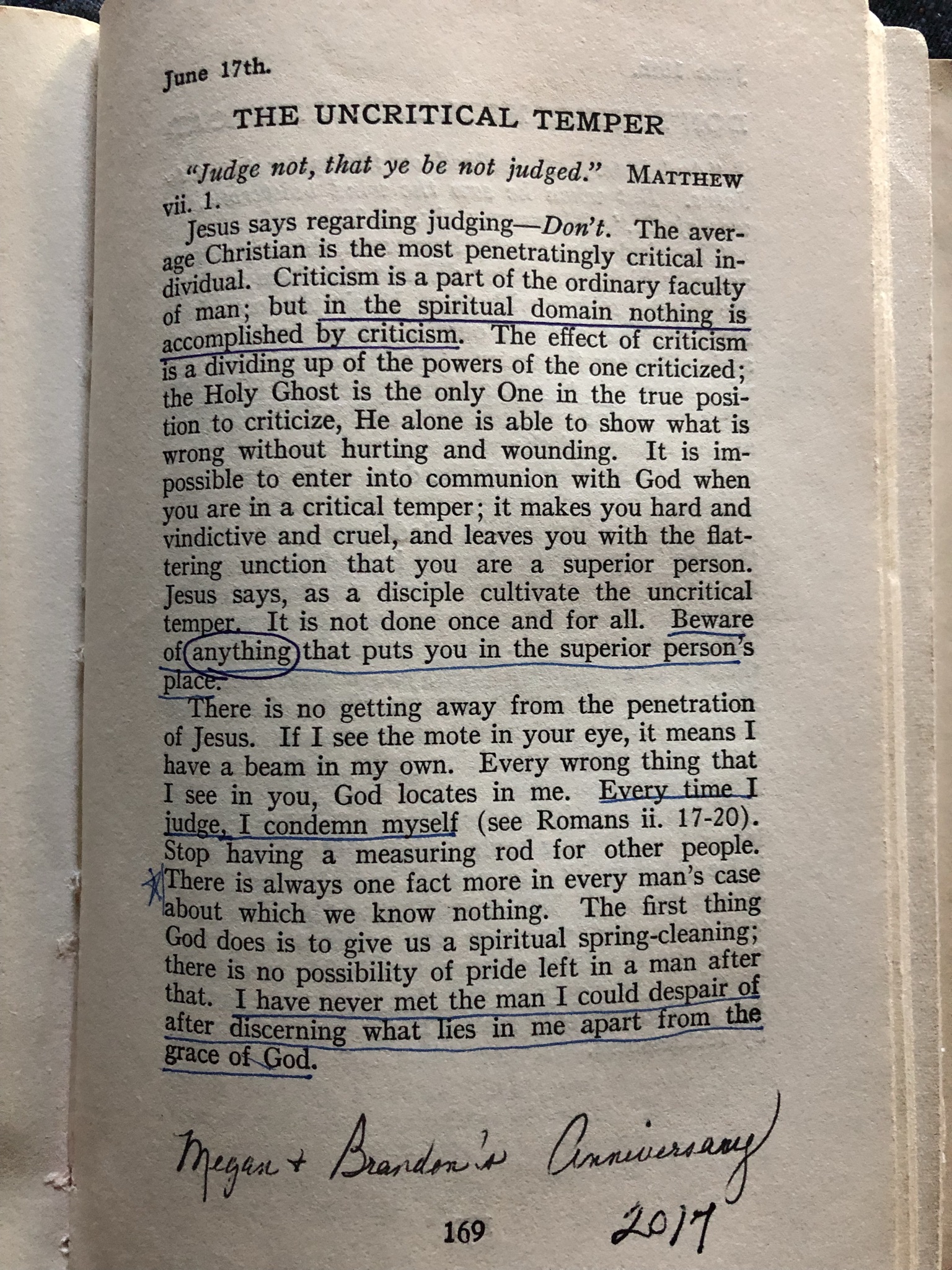
Thursday, June 17, 2021

My Utmost for His Highest - June 17th - The Uncritical Temper

Judge not, that ye be not judged. - Matthew 7:1

    Jesus says regarding judging — Don’t. The average Christian is the most penetratingly critical individual. Criticism is a part of the ordinary faculty of man; but in the spiritual domain nothing is accomplished by criticism. The effect of criticism is a dividing up of the powers of the one criticized; the Holy Ghost is the only One in the true position to criticize, He alone is able to show what is wrong without hurting and wounding. It is impossible to enter into communion with God when you are in a critical temper; it makes you hard and vindictive and cruel, and leaves you with the flattering unction that you are a superior person. Jesus says, as a disciple cultivate the uncritical temper. It is not done once and for all. Beware of anything that puts you in the superior person’s place.

    There is no getting away from the penetration of Jesus. If I see the mote in your eye, it means I have a beam in my own. Every wrong thing that I see in you (see Matthew 7:3-5), God locates in me. Every time I judge, I condemn myself (see Romans 2:17-20). Stop having a measuring rod for other people. There is always one fact more in every man’s case about which we know nothing. The first thing God does is to give us a spiritual spring-cleaning; there is no possibility of pride left in a man after that. I have never met the man I could despair of after discerning what lies in me apart from the grace of God.

Mom's Notes
Megan and Brandon's Anniversary 2017

My Notes
Chambers I believes brings up the key words about criticism here and that is that it is difficult to do with out hurting or wounding others and it often points out the person doing the criticism as the superior individual. So we must beware of anything that puts us in this superior position. Stop having a measuring rod for people. 

 - From Oswald Chambers, "My Utmost for His Highest" - Classic Edition

Highlights and Underlines are courtesy of Mom from her print edition


Monday, November 18, 2019

My Utmost for His Highest - November 18 - Winning into Freedom

If the Son therefore shall make you free, ye shall be free indeed. — John 8:36

If there is any remnant of individual conceit left, it always says – “I can’t.” Personality never says – “I can’t,” but simply absorbs and absorbs. Personality always wants more and more. It is the way we are built. We are designed with a great capacity for God; and sin and our individuality are the things that keep us from getting at God. God delivers us from sin: we have to deliver our selves from individuality, i.e., to present our natural life to God and sacrifice it until it is transformed into a spiritual life by obedience.
God does not pay any attention to our natural individuality in the development of our spiritual life. His order runs right across the natural life, and we have to see that we aid and abet God, not stand against Him and say – “I can’t do that.” God will not discipline us, we must discipline ourselves. God will not bring every thought and imagination into captivity; we have to do it. Do not say – “O Lord, I suffer from wandering thoughts.” Don’t suffer from wandering thoughts. Stop listening to the tyranny of your individuality, and get emancipated out into personality.
“If the Son…shall make you free…” Do not substitute “Saviour” for “Son.” The Saviour sets us free from sin; this is the freedom of being set free by the Son. It is what Paul means in Gal. 2:20 – “I have been crucified with Christ,” his natural individuality has been broken and his personality united with his Lord, not merged but united; “ye shall be free indeed,” free in essence, free from the inside. We will insist on energy, instead of being energized into identification with Jesus.

Mom's Notes
  • 2017 Noah and Ella Wedding
My Thoughts
  • conceit - excessive pride in oneself
  • God designs us to great things for God - our problem is ourselves
  • Do not say, "God I am suffering from wandering thoughts, help me." No instead stop listening to your individuality

Sunday, July 21, 2019

Jeremiah 13

I was very much moved by this passage from Jeremiah 13 because it amazes me, though I suppose it should not, when I see how relevant the word of God is to the time of today. As I read these words and study them I am amazed that they are so relevant to today. As a reminder, I have been working on reading the Bible daily, - following the M'Cheyne Reading Plan "Secret." Yet, I struggle and fail often. It takes time for me to study and my time gets displaced often. But, I am thankful for coming back to the Word. Today I read from Jeremiah 13 and I have prepared this outline based upon my thoughts from Enduring Word.


TWO WARNING SIGNS

The Sign of the Linen Sash

Hiding the linen sash - verses 1-5
  • Lord tells Jeremiah - Get a sash (decorative belt) and put it around your waist (1)
  • Sash was a priestly garment for High Priest and Regular Priest - a sign of dignity and nobility
  • Go to Euphrates (not sure if this was actual journey or vision) for if it would have been a 3 month journey that would have alarmed people of Anaathoth (4)
  • Hide the sash in a rock (4)
  • The direction of the Euphrates was where Babylon would be coming from to destroy Judah

Finding the Decayed, Useless Sash - verses 6-7
  • Go to the Euphrates and retrieve the sash (6)
  • It was still there, but had deteriorated and was ruined, good for nothing (7)

Ruining the Pride of the People - verses 8-11
  • In the same manner of the sash, the pride of Judah and Jerusalem will be ruined (9)
  • These people would be taken to the Euphrates and beyond
  • 3 main sins of Judah (10)
    • Refuse to hear God's words (Not reading His Word)
    • Follow the dictates of their hearts (trusted in themselves, looked to self instead of the Lord)
    • Walked after other gods to serve them (trusting in themselves, they were led to idolatry)
  • As the sash clings to a man, so we are to cling to God
  • But they would not listen (11)

The Sign of the Wine Bottle

Every bottle filled with wine - verse 12
  • Every bottle shall be filled with wine echoes the proverb - Everything will fulfill its purpose

The people of Judah drunk and destroyed - verses 13-14
  • Wine breaks people and God's rebellious people would be in a state of stupor and stupidity, drunk with wine (13)
  • The people would be dashed against one another (fighting among themselves - we are really seeing this today like never before) (14)

How to Respond to God's warnings

Humble yourself and give glory to the Lord - verses 15-16
  • We are told of the biggest problem we have for not listening to God - our pride (15)
  • "For the Lord has spoken" - as he speaks we have a choice on how we will respond - yea or nay
  • Thus, give glory to God before darkness is all we know (16)

The price to be paid for not heeding God's warnings - verses 17-20
  • Jeremiah didn't merely observe, he experienced weeping and tears because judgment was coming (17)
  • And so he keeps pleading "humble yourselves" (18)
  • It should begin with the leaders - King and Queen (18)
  • The invaders are coming for the beautiful sheep (20)

The guilt of those whom the Lord punishes - verses 21-23
  • When the punishment actually happens, the people were incredulous that such calamities had overtaken them (21), just as a woman in labor would exclaim "Why have these things come upon me?" (21,22)
  • Them (enemies) are taught to be lords (chieftans) over them (21)
  • Your skirts have been removed (22)
    • Judah commits spiritual adulteries and they would be terribly and tragically violated by their conquerors
    • "Lift up the skirt" is a euphemism for sexual attack both here and elsewhere in the OT
  • Can the Ethiopian change his skin or leopard his spots? (23)
    • God changes/transforms the nature of man

The determination of the Lord to scatter His people - verse 24-25
  • Their lot was to be scattered across the Babylonian empires (24)
  • And because you have forgotten Me and trusted in Falsehood (25)

The exposed shame of God's people - verses 26-27
  • For not humbling oneself, a greater shame results (26)
  • The Lord exclaims that they still are not clean (27)

Promise: In this chapter is the promise that the primary sins of Judah can also be sins of our day and they are not reading God's word, trusting in ourselves and in turn trusting in idolatry.

Prayer: Lord, thank you for the truth of your word and showing me continually the importance of listening to you and keeping my focus on You. Not on You means it will be on me and I will find fulfillment instead with me. Lord, I pray that I will humble myself and I would get out of the way from what you are teaching me and accept it.

Monday, November 26, 2018

Mark 14:66-72 - The Rooster Crow

Mark 14:66-72
66 As Peter was below in the courtyard, one of the servant-girls of the high priest *came, 67 and seeing Peter warming himself, she looked at him and *said, “You also were with Jesus the Nazarene.” 68 But he denied it, saying, “I neither know nor understand what you are talking about.” And he went out onto the porch. 69 The servant-girl saw him, and began once more to say to the bystanders, “This is one of them!” 70 But again he denied it. And after a little while the bystanders were again saying to Peter, “Surely you are one of them, for you are a Galilean too.”71 But he began to curse and swear, “I do not know this man you are talking about!” 72 Immediately a rooster crowed a second time. And Peter remembered how Jesus had made the remark to him, “Before a rooster crows twice, you will deny Me three times.” And he began to weep.

Message: The Rooster Crow

Time: Mark's personal connection with Peter gave him the source material for this book. This book was composed probably between AD 57 and AD 59. It's a book that is on the move, leading to the cross. 39 times is the word 'immediately' used. Mark reveals Jesus as God's servant, reaching into the lives of people and effecting physical and circumstantial change.

What the Lord is Saying:

Preface - Jesus has just been convicted and sentenced to death by the high priest and the people began to spit on and fist pump Jesus. The reason for his conviction is a culmination of events of how the priests have been threatened by Jesus since he has come on the scene. And now Jesus himself has confessed that He is the Messiah, the Son of God and that He will be at the right hand of God. The charge to Jesus is blasphemy. It is Thursday, in the middle of the night, about 3 am. Peter and John are nearby having followed the assembly of people to the court area to see what would happen.

As Peter was below in the courtyard, one of the servant-girls of the high priest *came, and seeing Peter warming himself, she looked at him and *said, “You also were with Jesus the Nazarene.” Jesus has already had made bold predictions about future events - his death and resurrection and then also the scattering of the sheep and how they would reject him. And now in this moment Jesus was not only being arrested but now spit on and beaten. The disciples initially fled when Jesus was arrested, but then curiosity led them to where the courts were accusing him. But, they are reverting back to their previous position now of innocence. What makes this denial more significance was how the accusation was insignificant. It wan't the high priest making the church, but a servant and a servant girl of the high priest. Peter took this as possible future danger.

How often has this occurred in life when I have shrugged off my affiliation with God or things spiritual simply out of a fear of being associated with Jesus. I have a danger in life of blending in, not going against the flow. Peter's response is:

1. But he denied it, saying, “I neither know nor understand what you are talking about.”

And he went out onto the porch. The servant-girl saw him, and began once more to say to the bystanders, “This is one of them!” The first time was alone and now she says the same thing but with an audience.

2. But again he denied it. 

And after a little while the bystanders were again saying to Peter, “Surely you are one of them, for you are a Galilean too.” Now it has gone from the servant-girl to the bystanders. So, there is no trial at all, no association at all with a high priest, just harmless people who possible were involved in the spitting on. But, the result is the same.

3. But he began to curse and swear, “I do not know this man you are talking about!”

It is a sad affair as Peter has clearly denied His affiliation with Jesus. He denies being a part of the group of people following Jesus and then he makes it clear that he doesn't even know Jesus. He clearly shows that he has nothing to do with Jesus whatsoever.

Immediately a rooster crowed a second time. And Peter remembered how Jesus had made the remark to him, “Before a rooster crows twice, you will deny Me three times.” And he began to weep. In the moment of it occurring we are concerned about the audience, but then afterward, we are convicted and see first hand that what we have done is what we have said we do not want to do and that is deny our association with Jesus.

Summary - Jesus has been accused of a crime and Peter has been a witness to this. The crime is being the Messiah, the Son of God. The high priests servant girl asks him by herself, then in the company of bystanders and then the bystanders themselves ask - Peter denies being part of the group of followers and then denies even knowing Jesus. But, apart from the group, Jesus is embarrassed by His actions and weeps over his sin of denial.

Promise: It is good to think of our sin for then the Holy Spirit will remind us of our sin. This is the mark of a Christian.

Prayer: Lord, I need to be aware of my sin more. Remind me of my wrongdoing. I too quickly justify My behavior. I too quickly spend time protecting myself from any accusation. I gather with Christians and proclaim Your name but before men I go along with the crowd. Forgive me Lord. Forgive me Lord. I am embarrassed before You My God. Lord, if I can help others see this, show me the Way. 


Monday, April 9, 2018

Mark 7:20-23 - Evil in Heart

Mark 7:20-23

20 And He was saying, “That which proceeds out of the man, that is what defiles the man. 21 For from within, out of the heart of men, proceed the evil thoughts, fornications, thefts, murders, adulteries, 22 deeds of coveting and wickedness, as well as deceit, sensuality, envy, slander, pride and foolishness. 23 All these evil things proceed from within and defile the man.”

Message: Evil in Heart

Time: Mark's personal connection with Peter gave him the source material for this book. This book was composed probably between AD 57 and AD 59. It's a book that is on the move, leading to the cross. 39 times is the word 'immediately' used. Mark reveals Jesus as God's servant, reaching into the lives of people and effecting physical and circumstantial change.

What the Lord is Saying:

Preface: Jesus speaks to all the people, going beyond just the scribes, and declares clearly that when speaking of being clean, the key is what comes out of a person, not what is taken in. What is unneeded to the human body are thrown off and eliminated through waste. If the people want to know what defiles, it is what comes out of a person that matters most. Jesus is declaring this radical message over and over - the heart. We need to focus on the heart. 

Jesus is emphasizing that what comes into a man - be it drink or food, even eating with unclean hands is not what defiles a person, but rather that which proceeds out of the man, that is what defiles the man. There is a clear contrast here that he is emphasizing.The Pharisees and scribes questioned why the disciples were not maintaining the tradition of hand washing that was thought to render people clean. Ultimately, Christ explains that cleanliness is an interior matter. It is the state of one's heart that determines cleanliness for the heart is the origin of all uncleanness. Before any sinful deed can be committed, it is conceived in the heart. For from within, out of the heart of men, proceed evil thoughts...All these evil things proceed from within and defile the man. 

God and man see people differently. This, to me, further emphasizes the radical nature in which Jesus came. I Samuel 16:7 says, But the Lord said to Samuel, “Do not look at his appearance or at his physical stature, because I have refused him. For the Lord does not see as man sees; for man looks at the outward appearance, but the Lord looks at the heart.” This verse reminds me of the way God has always been and therefore God sees in a way that man does not see. Naturally, we look at the outward and our prisons are set up because people have committed outward violations. The civil law is set up like this. But, God and Jesus go beyond the outward to the inner. This must be a difficult thing for society to comprehend for everywhere we are trained in the idea of the outward, but everyone God trains us on what is on the inside that matters most. 

Here sins are listed to clearly show their inner origins: fornications, thefts, murders, adulteries, deeds of coveting and wickedness, as well as deceit, sensuality, envy, slander, pride and foolishness. The first six in this list are acts that are seen outside of the flesh while the second six are attitudes behind the acts. 

First on the list is fornications. It is interesting for there is such a great power of sexual sin and sexual temptation that has been present in every culture of man. It was a problem 2,000 years ago and it is a problem today. The internet in the last 25 years has seen the proliferation of this sin. This is a sin that seeks to become more and more private.

Second is thefts. To be a thief is obviously abhorrent in society. But, for me, the acts of being a thief are changing. We most definitely grade this sin, in that taking a dollar versus $100 is seen a way different. With the advent of movies in the home came forth the issue of piracy. Even the internet and youtube made piracy of music more prevalent to the point that they had to figure out a way to make money on listening to music and now it has become the norm to listen in this manner. 

Third is murders. For me, personally, Roe v Wade in 1973 was the biggest change that occurred over the issue of murder for society accepted that murder of the fetus was warranted based upon a woman's choice. In the nineties, doctor assisted suicide started to appear as we looked at the other end of the spectrum, the elderly. Again, sin began to be disguised as warranted behavior. Society still today does not view either of these as murder. 

Fourth is adulteries. Adultery is not a new thing. It is a sexual sin practice that has been present for thousands of years. As a person that loves to watch old movies, adultery in the movies has always been present. There was a notion that if one was wealthy then they more easily could afford a mistress. The woman as an object of the man's desires crept more and more into people's thoughts and was then culminated with pornography being viewed as entertainment. 

Fifth is coveting. Coveting is a internal desire seen outwardly. Consumerism has made coveting a normal practice. The desire to have what your neighbor possesses is viewed as competition and moves us to be a strong business person. 

Sixth is wickedness. This is all kinds of wicked behavior. Thus, anything not covered previously is covered here. 

This is what we see and now Jesus focuses on what is on the inside. Deceit means lying, not telling the truth, deceptiveness, false witness. Lying can be pretending to be something we are not. Lying shows up in church all the time as people want to pretend to others that they are religious in order to get acceptance from society. 

Sensuality shows up in our behavior and speech. It is a dirty mind. Once again, society has made having a dirty mind being completely acceptable. Its amazing to think of the TV sitcoms and their attitudes and behaviors that made having a dirty mind comedic.  

Envy is to look with hate or to look with anger. 

Slander is to have abusive speech such as blasphemy. I went and saw a movie yesterday, one I should have avoided for the slander or abusive language that occurred in the movie, all under the disguise of laughter and entertainment was incredible and the most haunting thing was to witness children in the movie laughing at themes most likely they did not understand at all, but only laughed because their parents also laughed beside them. 

Pride is the feeling of being superior to others. And then foolishness, to be unthinking or senseless.

The issue that I'm seeing more and more is the normalizing of these sins in society. We don't think of these in a serious light because we have such a thirst for entertainment that we excuse these behaviors because they have made us laugh or enjoy life. 

Summary - Jesus, in a way, concludes the utter defilement of the heart by naming a list of these sins and repeats the idea that evil comes from within. While we stare at the outward, it is what is on the inside that matters most.  

Promise: Sin and holiness are fundamentally issues of the heart. Although holiness can be faked before men, God is never fooled. 

Prayer: Lord, I want to walk in holiness. I thank you for forgiving me of my sins and I'm embarrassed of how prevalent these sins continue to be in my life. I should know better. Thank you for the reminder and continue to clean me up, not only so that my witness is better but so that I can have peace with myself in life. 

Thursday, January 12, 2017

Proverbs 6:16-17 - Three Things the Lord Hates

Proverbs 6:16-17
16 There are six things which the Lord hates,
Yes, seven which are an abomination to Him:
17 Haughty eyes, a lying tongue,
And hands that shed innocent blood,


Promise: Three Things the Lord Hates

Time: It seems that Proverbs was written and then compiled sometime between the tenth and sixth centuries B.C. Proverbs was probably written during the reign of Solomon, 971-931 B.C.

What the Lord is Saying: 

This is interesting. Obviously, Solomon seems to be speaking to a group of people, reminding them of what God hates. Chapter 6 has been summarizes as parental counsel. It is interesting, it starts with son being snared by the words of your mouth. Be on guard for what your mouth can lead you to do. We need to careful with our words. And then there is a warning to the sluggard and the speaker brings up the ant. How in some ways humiliating that he looks at the smallest creature whereby a baby's footprint could smash it and yet he looks to that creature as an example for hard work. The ant keeps working, no matter the obstacles, the ant is working. The ant is either working or sleeping. Get up. Stop just sleeping. Wake up and get busy. Then, he addresses one with a perverse mouth. This person is a wicked man, a worthless person. This chapter is shaping up to be a chapter about the mouth.

Then he emphasizes 6 things the Lord hates, but it's not just six, it's seven. This isn't a new section, just a new subject. He is continuing his counsel.

And today i look at the first three:

  • Haughty eyes - This is thinking more highly of myself than I ought. At the start of the day, I must understand who I am. I am a child of God. I am a child. He is God. He is my father. I am not to think more of myself than is necessary. This doesn't have anything to do with self-esteem which is believing in myself. I have no reason to not believe in myself because God loves me and I am his child. I have confidence in who I am, for sure, but here I am simply realizing that God is always in charge. I need to be careful that I don't put to much credence on my own work, thinking that I control outcomes. I surrender to God and he is in charge. This is the opposite of the fear of God. It is being humble. I can definitely say, "I can do this" but not "I'm good." Only God is good and I can do this because God is on my side. This pride is the beginning of all other sins. The only reason I disobey God's commands is because I think I can. I want it my way. And my eyes are the giveaway. In Ephesians 4:2, Paul begins with a list of virtues and he begins with "Humility" or the opposite of pride.  
  • Lying tongue - The speaker now mentions the tongue. After beginning with pride, the beginning of all other sins, he mentions once again the tongue. Earlier, at the beginning of this chapter was a warning about being snared by the words of our mouth. But, lying wasn't the focus there, but rather it was more being careful about our words and those words getting ourselves in trouble. And then there was a warning about having a perverse mouth. Once again, the mouth is ugly and can degrade people, belittle them. Those were warnings about the mouth. And now, he addresses a lying tongue. Jesus is the Truth. If I speak untruth then I am in opposition to God and I show no regard for God's character. Lying harms me and it can harm other people. I admit, I have struggling with lying most of my life. I really struggled with it as a kid, all growing and through college. I can remember specific ways that I lied. I felt it necessary to just tweak the truth. I wanted people to see me a little better so I changed words. Its horrible. I didn't trust that the person God had made was really good enough to present themselves before others. The reason I am a liar is because I practice lying.
  • Shedding of innocent blood - It is one thing to have pride and to think that your way is always the better way, but to then carry out the act and take away the life of another. The horrible thing I see about abortion is a person deciding which life is more important. A choice was made to have sex and now people are deciding the result needs to be removed. This verse speaks of innocent blood. It is not speaking of war, but is speaking of taking someone's life when they haven't done anything wrong. As I read the paper and hear of bombings and slayings and murders, repeatedly there are innocent lives being hurt. This 23 year old boy that went to a bible study and then opened fire on those there is someone thinking that he must decided who is worth keeping around. It's just not that far from abortion. We stare at this young man and give him the death penalty while the potential money is told, she had every right to make that choice. Are not both parties innocent?

Promise: Be careful about my thoughts, my mouth, and thinking I am in control.

My Prayer: Lord, help me to be guided by your truths. On my own, I am selfish and think I know what is best for me. Keep me centered on You, truly humble, and understanding that I am your child at all times. I can never get away from you nor do I want to. Guard me from haughty, prideful eyes, that think I know what is best. And forgive me for my lying tongue, for not trusting in the person you have made in me. And forgive us as a society for the taking of innocent lives.

Thursday, January 14, 2016

Proverbs 5:1-14 - The Trap of Adultery

Proverbs 5:1-14
My son, give attention to my wisdom, incline your ear to my understanding;
That you may observe discretion and your lips may reserve knowledge.
For the lips of an adulteress drip honey and smoother than oil is her speech;
But in the end she is bitter as wormwood, sharp as a two-edged sword.
Her feet go down to death,  her steps take hold of Sheol.
6 She does not ponder the path of life; her ways are unstable, she does not know it.
Now then, my sons, listen to me and do not depart from the words of my mouth.
Keep your way far from her and do not go near the door of her house,
Or you will give your vigor to others and your years to the cruel one;
10 And strangers will be filled with your strength and your hard-earned goods will go to the house of an alien; 
 11 And you groan at your final end, when your flesh and your body are consumed;
12 And you say, “How I have hated instruction! And my heart spurned reproof!
13 “I have not listened to the voice of my teachers, nor inclined my ear to my instructors!
14 “I was almost in utter the midst of the assembly and congregation.”

Message: The Trap of Adultery

Time: It seems that Proverbs was written and then compiled sometime between the tenth and sixth centuries B.C. Proverbs was probably written during the reign of Solomon, 971-931 B.C.

What the Lord is Saying:

The focus of today's passage is on adultery. This is long because it is meant to be clear. This is not fire to play with.

One thing that I looked at and noticed in my study yesterday of Proverbs 1, was that people are enticed and taken away by something often in their life. I often call this a temptation or that I have wandered off path and are engaging in sin. In actuality, in the Bible, this is referred to as having an idol in our lives. Idolatry is anything in our lives that we do to bring us joy and we do it in order to give us peace about life. We do it to give us joy. Our joy is not found in Christ, but it is found in this other thing that isn't just a part of our life but it becomes often what keeps us going. It becomes what we spend our money on or what we spend most of our time on. It becomes what we think about. And over time, God and His word are replaced more and more. No longer am I surrendering to God and His word and thinking that God's word is the highest source of good in my life. Now, I see this idol as that which can give me joy.

Their is idolatry in: video games, TV watching, Movie watching, eating, shopping, music, smoking, drinking alcohol, drugs, friends. There are many different idols in our lives, some not even so sin apparent.

This is rampant in our lives. The idol could be anything and often with people, it is anything. And yet what most people find, when they are honest with themselves is this idol does not necessarily bring them lasting joy. There isn't a peace in life like there is when Christ is on the throne. Testimonies from people resonate this when they say, "I tried ........ and it never brought complete satisfaction, but then I turned my life over to Christ and let Him take the reins and life became fulfilled."

In Proverbs 1:10-19 the enticement was friends that lured the pupil away to do things that were impure. The passage spoke of evil things but that evil could be anything. The key was it was with the wrong people, doing bad stuff, and that bad stuff ended up having a consequence. The last phrase of verse 19 says, "It takes away the life of its possessors." It's end is death. And today in this passage is immediately an equal warning as Solomon says in verse 5, "her feet go down to death; her steps take hold of Sheol."

What is it that I have done in my life to try and replace God in order to give me the peace and enjoyment that only He can bring? For me, money comes to mind. It's not that I have a lot, necessarily, but I often think that if I just had enough then life would be simpler. I say this because our wants are abundant and so I think that by having those things that I desire, and my family desires, that then I will be satisfied. Yet, I know it will be momentary because our desires never cease.

Very Important Subject Matter
First of all, I like how Solomon begins. Son, (1) Give your attention to me. Not an easy task sometimes in life to get someone to concentrate on what the other person is saying. Solomon clearly is saying that "I have something important to say. (2) Incline your ear to my understanding. Bend your ear not just to listen, but understand. We hear a lot of things each day, but how much do we really internalize or then practice? Solomon is saying to his pupils, what I have to say is meant to be followed. (3) That you may observe discretion. Retain these words in your heart. These words are my counsel to you. (4) Your lips may reserve knowledge. Literally, this is "Thy lips shall keep." This is life long understanding. This is life long "watch out." This is not momentary or just for a season. This is long-term. You need to be able to speak these words back to me. This is how important these words are. You need to be able to state this in your own words.

Warning
Verse 3 is interesting for the translation I have used has translated the word zur to mean adulteress. Zur is translated in the KJV as strange. The meaning is this is an apostate Israelite woman gone over to the idolatrous impurities of heathen religion. The idea of adultery here is someone that has traded in something they have been called to be for something else. It is not necessarily speaking of a woman that has started out with a husband and decided that her husband did not satisfy her desires, for whatever reason, and so is seeking out something else, not God-given, but what man has provided. God has been traded in for what people think is something better.

James 4:4 is a verse I have tried to memorize. It says, "You adulterous people! Do you not know that friendship with the world is enmity with God? Therefore whoever wishes to be a friend of the world makes himself an enemy of God." James is speaking to people that have chosen to trade or replace God with the things of the world and for this he speaks to the people as adulterers.

This is significant because what is being spoken of here is not simply reserved for married people that are seeking after other people in their life and are practicing sex with someone else in their life. It is true that is adultery. God has given you a gift of a mate and you are saying to God, "The gift that you gave me is not what I think I need; I choose someone else and I think that person will fulfill my needs."

The application then for Proverbs 5 is far reaching. Adultery here is actually treason or any idol that we might have in our life.

And the idol or whatever we are being tempted to have in our life drips with honey. It is sweet. It is appealing. It suits my tastes. It drips honey and smoother than oil is her speech.  I can see why the word adulteress was chosen because this woman is using flattering speech, smooth talk, offering something which man desires, alluring speech. This is not, "Come over and clean the toilet" no this is come experience your wildest dreams. 

Not as it appears
Verses 4-6 then basically say, "things are not as they appear." Though this strange woman has spoken with flattery and allured you in her direction, in the end she is bitter as wormwood, sharp as a two-edged sword. Her feet go down to death, her steps take hold of Sheol. She does not ponder the path of life; her ways are unstable, she does not know it. 

Wormwood is an herb and an eastern medicine this was looked upon as being poisonous. Wormwood is the complete opposite of wormwood. It reminds me of the movie Chitty Chitty Bang Bang and the man that lured people by showing them sweet candy on his truck and then when they crawled in the truck it turned into a cell block. It went from sweetness to being a prisoner. 

Solomon says it affects the body (feet go down to death) and affects the soul (steps take hold of Sheol/grave/hell). Idols in our life don't just want a part of our life, but they want your entire life. She does not ponder the path of life. In her is not a big picture. If we could see our entire life in a moment, upon making a decision, it would affect our decision making. There are ramifications for our choices, but if we train ourselves into not looking at those consequences then over time we no longer have any long-term perspective thinking.

Heinrich Albert Schultens (1749-1793) stated that the design of the wise man seems to be, to point out the inconstancy, irregularity, and wickedness, of the strange woman's life. Her ways are inconstant; she is not attached to her husband, or to any one man, but abandons herself to the first comer; has neither knowledge, wisdom, nor discernment; she has no other rule than her passion, no other end than her pleasure. She is profligate, and wholly lost; affected neither by the fear of God, nor the care of her own salvation.

Second Warning
As if one warning was not enough, Solomon gives a second warning. This is a very significant event. In verse 7 and 8 he states further to: (1) Listen to me; He said previously that he wanted the pupil's attention and wanted his ear bent to understand. He says again, "listen to me." Listen to what I am going to tell you. The pupil will now hear of the consequence. (2) Do not depart from the words of my mouth; Don't choose the path; do not depart from my words. (3) Keep your way far from her; The last warning I saw in Proverbs 1:10-19 was Keep your feet from their path. With this issue the feet are to be far from the path. (4) Do not go near the door of her house. To clarify further, do not even go near the door of the house. We all know that going inside is a disaster, but do not even go near the door. 

A Hard Life
In a way this final part is similar to "God gave them over" found in Romans 1 (one of my favorite passages). The warnings have occurred. The danger sign is in place. "Keep Out" has been posted. But, if that isn't enough, he will now detail the results of going down that wrong path.

Or you will give your vigor to others and your years to the cruel one - Your strength; your person; your life and your future, will be handed over to the cruel one. The idea of vigor is what your life has meant thus far. Other translations use the word honor. Who you are is being given away. 

And strangers will be filled with your strength and your hard-earned goods will go to the house of an alien. Everything you have worked for is gone.  

And you groan at your final end, when your flesh and your body are consumed; And you say, “How I have hated instruction! And my heart spurned reproof! I have not listened to the voice of my teachers, nor inclined my ear to my instructors! I was almost in utter the midst of the assembly and congregation.” Pride has taken over. Recovery in this moment is practically hopeless. 

Promise: Beware. Beware. Beware. Adultery always has destructive consequences. 


Saturday, June 6, 2015

Jesus Calling: June 6

Seek My Face, and you will find fulfillment of your deepest longings. My world is filled with beautiful things; they are meant to be pointers to Me, reminders of My abiding Presence. The earth still declares My Glory to those who have eyes that see and ears that hear.
     You had a darkened mind before you sought Me wholeheartedly. I chose to pour My Light into you, so that you can be a beacon to others. There is no room for pride in this position. Your part is to reflect My glory. I am the Lord!
Psalm 105:4
English Standard Version

Seek the Lord and his strength;
    seek his presence continually!

Psalm 19:1-2
English Standard Version

1 The heavens declare the glory of God,
    and the sky above proclaims his handiwork.
Day to day pours out speech,
    and night to night reveals knowledge.

Isaiah 60:2
English Standard Version

For behold, darkness shall cover the earth,
    and thick darkness the peoples;
but the Lord will arise upon you,
    and his glory will be seen upon you.

Note: The devotion and scriptures are from author Sarah Young. If you haven't already, please purchase the book and support the author.  

Also, bookmark https://bibletags.blogspot.com/2019/06/jesus-calling-366-days.html to have an easy link to the entire year of these entries.

Wednesday, April 29, 2015

Jesus Calling: April 30

     When some basic need is lacking--time, energy, money--consider yourself blessed. Your very lack is an opportunity to latch onto Me in unashamed dependence. When you begin a day with inadequate resources, you must concentrate your efforts on the present moment. This is where you are meant to live--in the present; it is the place where I always await you. Awareness of your inadequacy is a rich blessing, training you to rely wholeheartedly on Me.
     The truth is that self-sufficiency is a myth perpetuated by pride and temporary success. Health and wealth can disappear instantly, as can life itself. Rejoice in your insufficiency, knowing that My Power is made perfect in weakness. 
James 1:2
English Standard Version
Count it all joy, my brothers, when you meet trials of various kinds,

2 Corinthians 12:9
New American Standard
And He has said to me, “My grace is sufficient for you, for power is perfected in weakness.” Most gladly, therefore, I will rather boast about my weaknesses, so that the power of Christ may dwell in me.

My Prayer
Lord, You know me. You know me better than I know myself. And what you know about me would greatly embarrass me before others. You know my failures, my secret thoughts, everything about me. You know how hard I work many times to present myself before others as this person who looks good and plays the part and is highly esteemed and yet You know the real me. And that is the person that you love. I align myself so often with those that are strong or who exhibit strength and you accept me in my weakness. And in that weakness you make me strong. And what I need to be is that real person. I don't deserve you God. Your grace amazes me. I could never repay you and you don't even want me to try. Thank You for dwelling in me, for taking up residence in me. O God I thank you.

Note: The devotion and scriptures are from author Sarah Young. If you haven't already, please purchase the book and support the author.     

Also, bookmark https://bibletags.blogspot.com/2019/06/jesus-calling-366-days.html to have an easy link to the entire year of these entries.

Friday, January 2, 2015

Romans 11:16-18 - Wild Olive Branches

Romans 11:16-18 - 16 If the first piece of dough is holy, the lump is also; and if the root is holy, the branches are too. 17 But if some of the branches were broken off, and you, being a wild olive, were grafted in among them and became partaker with them of the rich root of the olive tree, 18 do not be arrogant toward the branches; but if you are arrogant, remember that it is not you who supports the root, but the root supports you.

Message: Beware of feeling prideful

Time: Written in AD 57 from Greece, to the Christians, both Gentile and Jewish in Rome.
 
What the Lord is Saying:


From the Amplified: Now if the first handful of dough offered as the first fruits [Abraham and the patriarchs] is consecrated (holy), so is the whole mass (or lump) [the nation of Israel]; and if the root [Abraham] is consecrated (holy), so are the branches [the natural ethnic Jews]. But if some of the branches [the ethnic Jews] were broken off, while you, a wild olive shoot [believing ethnic Jews and Gentiles] were grafted in among them to share the richness [of the root and sap] of the olive tree, Do not boast over the branches [All Jews] and pride yourself at their expense. If you do boast and feel superior, remember it is not you that support the root, but the root [that supports] you.

Once a person belongs to something special and even a group that has an elite distinction, often what occurs is pride or a feeling that one earned their way into this situation. Pride may be one of the chief sins in life. Os Guinness in his book Steering through Chaos looks at the 7 deadly sins and the first sin is pride.

Pride, to me, means that we think that we are in the position we are because of something we have done and also, by being in the position we are, our position is greater than others. Pride rears its head in many different situations in life. At sporting events, the victor in the match might have pride. At a job, receiving a promotion or being a manager might result in pride. Any time a person receives recognition or a pat on the back or hears, "Job well done" pride can be at the fore front.

It is somewhat difficult to not have pride. I was reading, earlier this week, an article about being ordinary and this is something we are not encouraged to be in life, but instead we are often encouraged to be extreme or high or to stand out from the crowd. In raising children, I see this everywhere. It is hard because in raising children, I want my child to have confidence as this helps them to achieve goals and be productive. But, in that confidence should not be an elitist attitude.

I find this interesting and fascinating that Paul, after interjecting that the Gentiles, upon the sin of the Jew, received the gospel and the gracious gift of salvation, quickly comes to this illustration to present the message that these converts are not to boast over those that haven't been chosen. He wants them to remember that their position is not because of their own good works, but because of being placed with the distinguished one (Abraham, later Jesus Christ).

Wow, this is hard. It is so hard to not have the elitist thinking in life. I have done it so many times, but I must go back to Romans 1:21 which says "For even though they knew God, they did not give thanks." Our first response and here, the first that goes astray in the life of the God follower, is not giving thanks. I Thessalonians 5:18 says, "Thank God in everything." My first response is not to puff out my chest or clap that I am on the top podium or pat myself on the back or throw a bumper sticker on my car that declares my position or sneer at my adversary or opponent because I was the victor, but my first response is to "give thanks."

It is to say, "Thank you, Lord, for saving my soul, thank you, Lord, for making me whole; thank you, Lord, for giving to me thy great salvation so rich and free."

It is interesting when sports figures often do this or ever stars or performers. It is interesting when the first they do upon winning a game or accepting an award is to thank God. This is accurate and fitting. This is correct. Our first response should always be that God is to be thanked.

Promise: As fallen human beings, we are constantly tempted to believe that the reason we are Christians is that we are somehow better than others. Even within the church, we are tempted to believe that we have a monopoly on God's grace and that others who are not part of our denomination are second-class citizens in the kingdom of heaven. If we ever find this feeling in ourselves, let us repent. 


. 


Thursday, December 26, 2013

Daniel 4

Message: Nebuchadnezzar recounts the work that the "Most High God" has done for him. 

Time: King Nebuchadnezzar reigned for 43 years (605-562BC). It is difficult to assign a specific date as their is no internal evidence from the Bible to identify a date. John MacArthur stated that Daniel 4 occurred 25-30 years after Daniel 3 and the fiery furnace. Daniel was about 45 to 50 years of age at this time.

What the Lord is Saying: It is interesting that in King Nebuchadnezzar's words he proclaims the greatness of God and his signs and wonders, yet we don't see that King Neb. is necessarily a Christian because God only became great to him after he saw miracles. He called God chief of the holy gods so he believed there was more than 1 god. In this telling, Nebuchadnezzar recounts the dream and what he remembers. And then recounts Daniel's interpretation. 

And then Nebuchadnezzar speaks as to the fulfillment of the dream, talking about what occurred 12 months later. After he saw that he ruled over all, a voice from heaven told him that it would be taken from him. And he will live in the fields with wild animals, eating like a cow, until he learns that God's sovereign control is over all.

And yet now Nebuchadnezzar offers a praise and worship of the Lord most High.

His rule and kingdom is eternal.
No one can compare with Him.
He does as he determines.
No one can stop Him or say to Him, "Why are you doing this?"
God's acts are just and true.
He humbles the proud.

This chapter is a chapter of contrast. King Nebuchadnezzar's empire was great. It was large and his power immense over many kingdoms. He had every reason to be puffed up with pride. Daniel in his interpretation asked Nebuchadnezzar to repent, stating that this is what would set him free (4:27).

Promise: Everyone, no matter the stature or position, will be humbled. But, that humility won't be what saves them.


Wednesday, October 23, 2013

Ezekiel 29

Message: A message of prophecy to Pharaoh and the people of Egypt.

Time: January 7, 10 year of King Jehoiachin's captivity. Message came to Ezekiel from the Lord. This is about 571 BC.

What the Lord is Saying:

The Lord states that he is Pharaoh's enemy. And with that he lets Pharaoh know that the Nile river does not belong to Pharaoh like Pharaoh claims. He condemns Egypt for the way they treated Israel in their time of need. The prophecy states that the people will be dragged away. And no one will inhabit the Nile river. It does not state the area will no longer be a land, but that it would be ruined and (Nebuchadnezzar) would take home spoil from his campaign of it. However, it also mentioned a 40 year desolation of the land and it is possible that this prophecy is yet to be fulfilled. And then the Lord will bring Egypt back and He will restore the people to their land, but Egypt will never be a prominent place.

Verse 16 mentions that then Israel will not be tempted to put their trust in Egypt. This is interesting as God wants to remind Israel that He is the only one that should be trusted. That people cannot be trusted.

The Lord gives Nebuchadnezzar a reward of Egypt for their efforts in carrying out the Lord's judgment on Tyre.

Promise: Verse 21 is a reminder to the people that the day will come when Israel will be revived. Also, Ezekiel's words will be respected. And the people will know the Lord.